Datasheet4U Logo Datasheet4U.com

MAX3296 - LAN Laser Drivers

Download the MAX3296 datasheet PDF. This datasheet also covers the MAX variant, as both devices belong to the same lan laser drivers family and are provided as variant models within a single manufacturer datasheet.

General Description

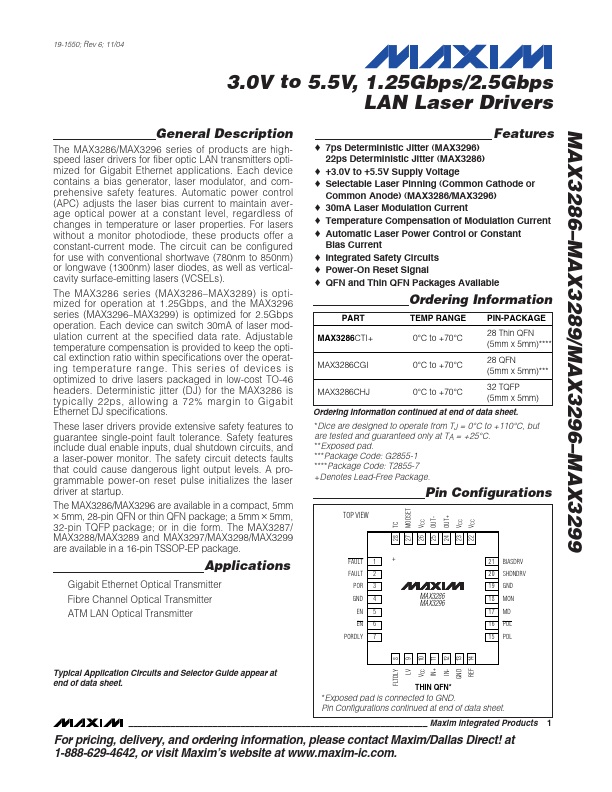
The MAX3286/MAX3296 series of products are highspeed laser drivers for fiber optic LAN transmitters optimized for Gigabit Ethernet applications.

Key Features

  • Automatic power control (APC) adjusts the laser bias current to maintain average optical power at a constant level, regardless of changes in temperature or laser properties. For lasers without a monitor photodiode, these products offer a constant-current mode. The circuit can be configured for use with conventional shortwave (780nm to 850nm) or longwave (1300nm) laser diodes, as well as verticalcavity surface-emitting lasers (VCSELs). The MAX3286 series (MAX3286.
  • MAX3289) is optimized fo.

📥 Download Datasheet

Note: The manufacturer provides a single datasheet file (MAX-3297.pdf) that lists specifications for multiple related part numbers.

Full PDF Text Transcription (Reference)

The following content is an automatically extracted verbatim text from the original manufacturer datasheet and is provided for reference purposes only.

View original datasheet text
19-1550; Rev 6; 11/04 3.0V to 5.5V, 1.25Gbps/2.5Gbps LAN Laser Drivers General Description The MAX3286/MAX3296 series of products are highspeed laser drivers for fiber optic LAN transmitters optimized for Gigabit Ethernet applications. Each device contains a bias generator, laser modulator, and comprehensive safety features. Automatic power control (APC) adjusts the laser bias current to maintain average optical power at a constant level, regardless of changes in temperature or laser properties. For lasers without a monitor photodiode, these products offer a constant-current mode. The circuit can be configured for use with conventional shortwave (780nm to 850nm) or longwave (1300nm) laser diodes, as well as verticalcavity surface-emitting lasers (VCSELs).