

Datasheet4U Logo Datasheet4U.com

MAX9108 - 25ns / Dual/Quad/Single / Low-Power / TTL Comparators

Download the MAX9108 datasheet PDF. This datasheet also covers the MAX9107 variant, as both devices belong to the same 25ns / dual/quad/single / low-power / ttl comparators family and are provided as variant models within a single manufacturer datasheet.

General Description

The MAX9107/MAX9108/MAX9109 dual/quad/single, high-speed, low-power voltage comparators are designed for use in systems powered from a single +5V supply.

Their 25ns propagation delay (with 10mV input overdrive) is achieved with a power consumption of only 1.75mW per comparator.
Key Features

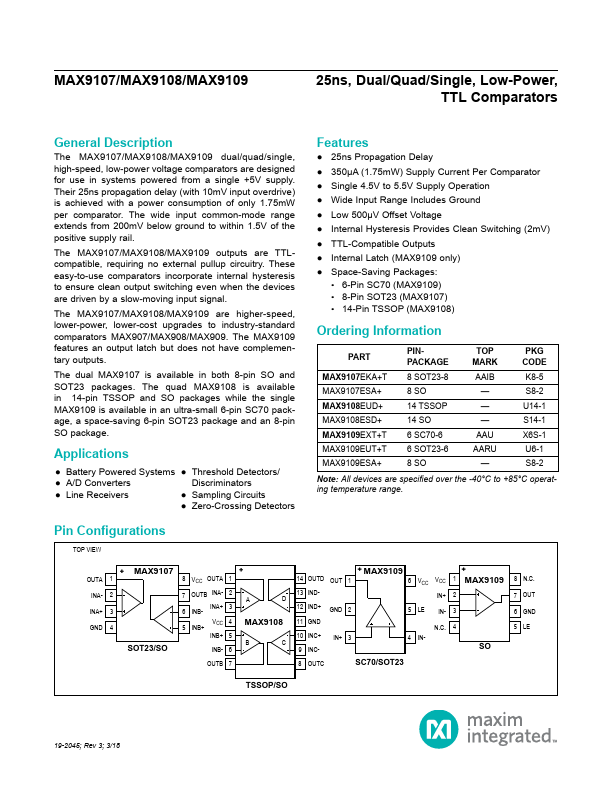
  • an output latch but does not have complementary outputs. The dual MAX9107 is available in both 8-pin SO and SOT23 packages. The quad MAX9108 is available in 14-pin TSSOP and SO packages while the single MAX9109 is available in an ultra-small 6-pin SC70 package, a space-saving 6-pin SOT23 package and an 8-pin SO package.

📥 Download Datasheet

Note: The manufacturer provides a single datasheet file (MAX9107_MaximIntegratedProducts.pdf) that lists specifications for multiple related part numbers.

Full PDF Text Transcription (Reference)

The following content is an automatically extracted verbatim text from the original manufacturer datasheet and is provided for reference purposes only.

View original datasheet text
19-2045; Rev. 2; 1/07 MAX9107/MAX9108/MAX9109 25ns, Dual/Quad/Single, Low-Power, TTL Comparators General Description The MAX9107/MAX9108/MAX9109 dual/quad/single, high-speed, low-power voltage comparators are designed for use in systems powered from a single +5V supply. Their 25ns propagation delay (with 10mV input overdrive) is achieved with a power consumption of only 1.75mW per comparator. The wide input common-mode range extends from 200mV below ground to within 1.5V of the positive supply rail. The MAX9107/MAX9108/MAX9109 outputs are TTLcompatible, requiring no external pullup circuitry. These easy-to-use comparators incorporate internal hysteresis to ensure clean output switching even when the devices are driven by a slow-moving input signal.