BMB2A0120RS2
Overview
- 2. 3. 4. 5.
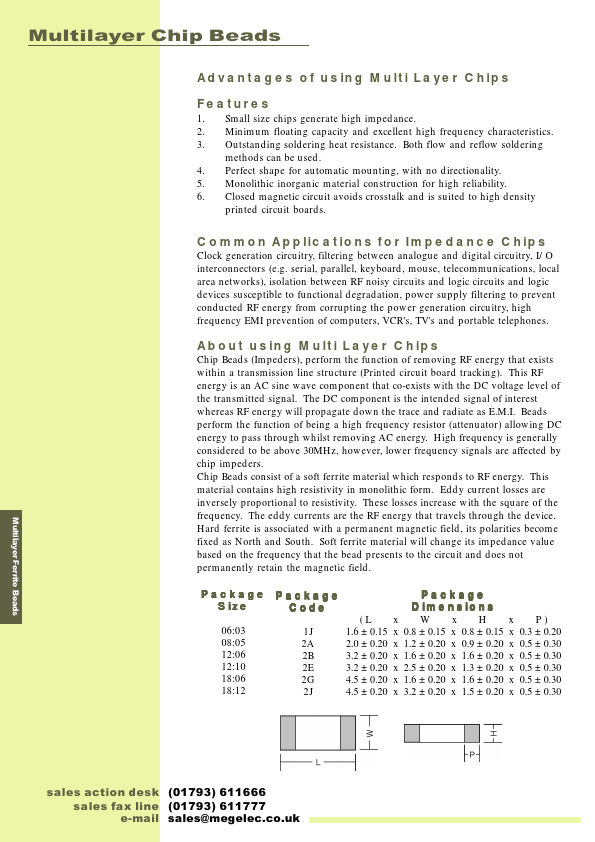
- Small size chips generate high impedance. Minimum floating capacity and excellent high frequency characteristics. Outstanding soldering heat resistance. Both flow and reflow soldering methods can be used. Perfect shape for automatic mounting, with no directionality. Monolithic inorganic material construction for high reliability. Closed magnetic circuit avoids crosstalk and is suited to high density printed circuit boards. Common Applications for Impedance Chips Clock generation circuitry, filtering between analogue and digital circuitry, I/O interconnectors (e.g. serial, parallel, keyboard, mouse, telecommunications, local area networks), isolation between RF noisy circuits and logic circuits and logic devices susceptible to functional degradation, power supply filtering to prevent conducted RF energy from corrupting the power generation circuitry, high frequency EMI prevention of computers, VCR's, TV's and portable telephones. About using Multi Layer Chips Chip Beads (Impeders), perform the function of removing RF energy that exists within a transmission line structure (Printed circuit board tracking). This RF energy is an AC sine wave component that co-exists with the DC voltage level of the transmitted signal. The DC component is the intended signal of interest whereas RF energy will propagate down the trace and radiate as E.M.I. Beads perform the function of being a high frequency resistor (attenuator) allowing DC energy to pass through whilst removing AC energy. High frequency is generally considered to be above 30MHz, however, lower frequency signals are affected by chip impeders. Chip Beads consist of a soft ferrite material which responds to RF energy. This material contains high resistivity in monolithic form. Eddy current losses are inversely proportional to resistivity. These losses increase with the square of the frequency. The eddy currents are the RF energy that t