MXD2020G
MXD2020G is Dual Axis Accelerometer manufactured by Memsic.
FEATURES
Resolution better than 1 mg Dual axis accelerometer fabricated on a monolithic CMOS IC Ro HS pliant On chip mixed mode signal processing No moving parts 50,000 g shock survival rating 17 Hz bandwidth expandable to >160 Hz 3.0V to 5.25V single supply continuous operation Continuous self test Independent axis programmability (special order) Ultra low initial Zero-g Offset
APPLICATIONS Automotive
- Vehicle Security/Vehicle stability control/
Headlight Angle Control/Tilt Sensing Security
- Gas Line/Elevator/Fatigue Sensing Information Appliances
- puter Peripherals/PDA’s/Cell Phones
Gaming
- Joystick/RF Interface/Menu Selection/Tilt Sensing
- electronic pass tilt Correction
Consumer
- LCD projectors, pedometers, blood pressure Monitor, digital cameras
GENERAL DESCRIPTION
The MXD2020G/H/M/N is a low cost, dual axis accelerometer fabricated on a standard, submicron CMOS process. It is a plete sensing system with on-chip mixed mode signal processing. The MXD2020G/H/M/N measures acceleration with a full-scale range of ±1.7 g and a sensitivity of 20%/g @5V at 25°C. It can measure both dynamic acceleration (e.g. vibration) and static acceleration (e.g. gravity). The MXD2020G/H/M/N design is based on heat convection and requires no solid proof mass. This eliminates stiction and particle problems associated with petitive devices and provides shock survival of 50,000 g, leading to significantly lower failure rate and lower loss due to handling during assembly.
Sck (optional)
Internal Oscillator
Temperature Sensor
Voltage CLK Reference
Heater Control
Continous Self Test
X axis
Low Pass Filter
Factory Adjust Offset & Gain
2-AXIS SENSOR
Y axis
VDD Gnd
Low Pass Filter
TOUT VREF
DOUTX DOUTY
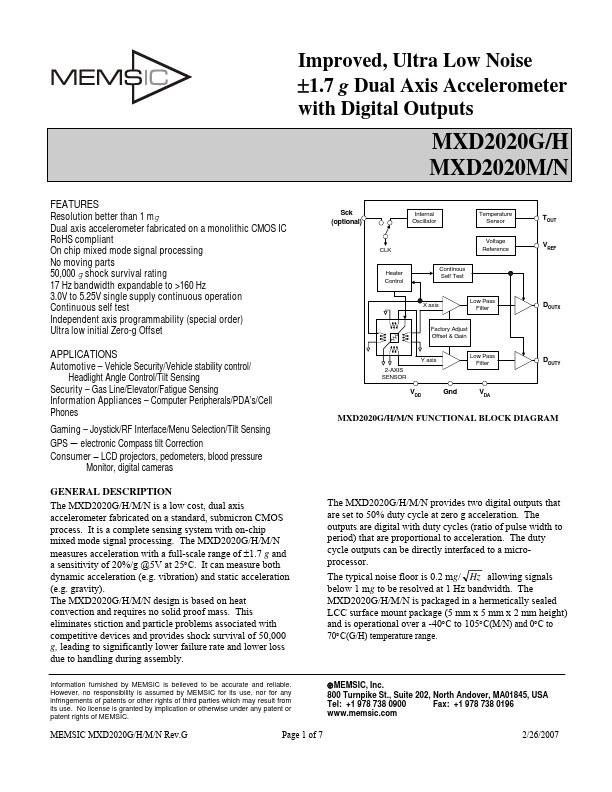
MXD2020G/H/M/N FUNCTIONAL BLOCK DIAGRAM
The MXD2020G/H/M/N provides two digital outputs that are set to 50% duty cycle at zero g acceleration. The outputs are digital with duty cycles (ratio of pulse width to period) that are proportional to acceleration. The duty...