
Datasheet4U Logo Datasheet4U.com

KSZ9031MNX - Gigabit Ethernet Transceiver

General Description

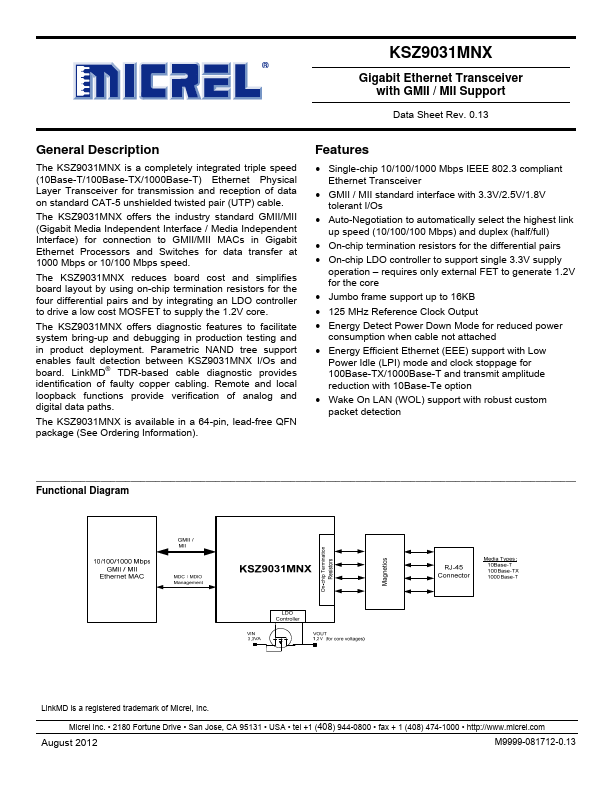
The KSZ9031MNX is a completely integrated triple speed (10Base-T/100Base-TX/1000Base-T) Ethernet Physical Layer Transceiver for transmission and reception of data on standard CAT-5 unshielded twisted pair (UTP) cable.

Key Features

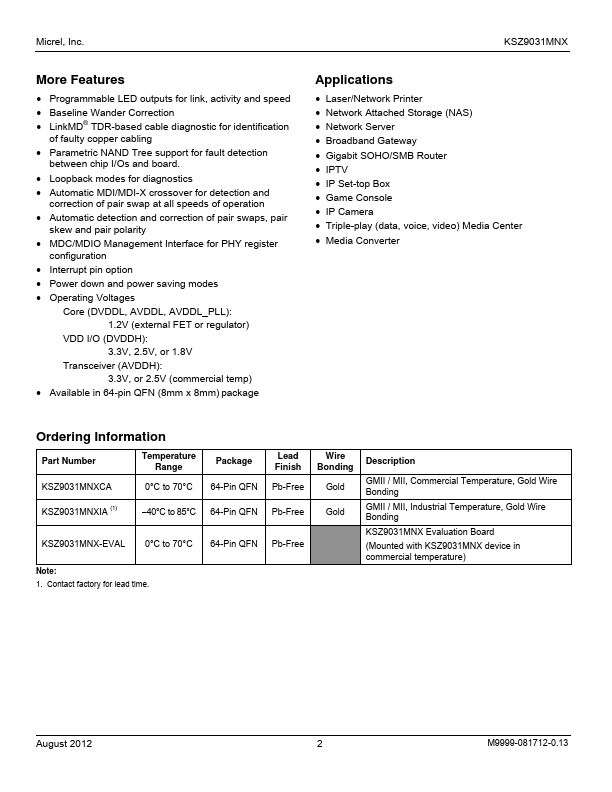
  • to facilitate system bring-up and debugging in production testing and in product deployment. Parametric NAND tree support enables fault detection between KSZ9031MNX I/Os and board. LinkMD® TDR-based cable diagnostic provides identification of faulty copper cabling. Remote and local loopback functions provide verification of analog and digital data paths. The KSZ9031MNX is available in a 64-pin, lead-free QFN package (See Ordering Information). Features.
  • Single-chip 10/100/1000 Mbps IEE.

📥 Download Datasheet

Datasheet Details

Part number KSZ9031MNX
Manufacturer Micrel Semiconductor
File Size 712.70 KB
Description Gigabit Ethernet Transceiver
Datasheet download datasheet KSZ9031MNX Datasheet

Full PDF Text Transcription for KSZ9031MNX (Reference)

Note: Below is a high-fidelity text extraction (approx. 800 characters) for KSZ9031MNX. For precise diagrams, and layout, please refer to the original PDF.

KSZ9031MNX Gigabit Ethernet Transceiver with GMII / MII Support Data Sheet Rev. 0.13 General Description The KSZ9031MNX is a completely integrated triple speed (10Base-T/...

View more extracted text
tion The KSZ9031MNX is a completely integrated triple speed (10Base-T/100Base-TX/1000Base-T) Ethernet Physical Layer Transceiver for transmission and reception of data on standard CAT-5 unshielded twisted pair (UTP) cable. The KSZ9031MNX offers the industry standard GMII/MII (Gigabit Media Independent Interface / Media Independent Interface) for connection to GMII/MII MACs in Gigabit Ethernet Processors and Switches for data transfer at 1000 Mbps or 10/100 Mbps speed. The KSZ9031MNX reduces board cost and simplifies board layout by using on-chip termination resistors for the four differential pairs and by integrating an LD