Datasheet4U Logo Datasheet4U.com

MIC2174C - Synchronous Buck Controller

Download the MIC2174C datasheet PDF. This datasheet also covers the MIC2174 variant, as both devices belong to the same synchronous buck controller family and are provided as variant models within a single manufacturer datasheet.

Key Features

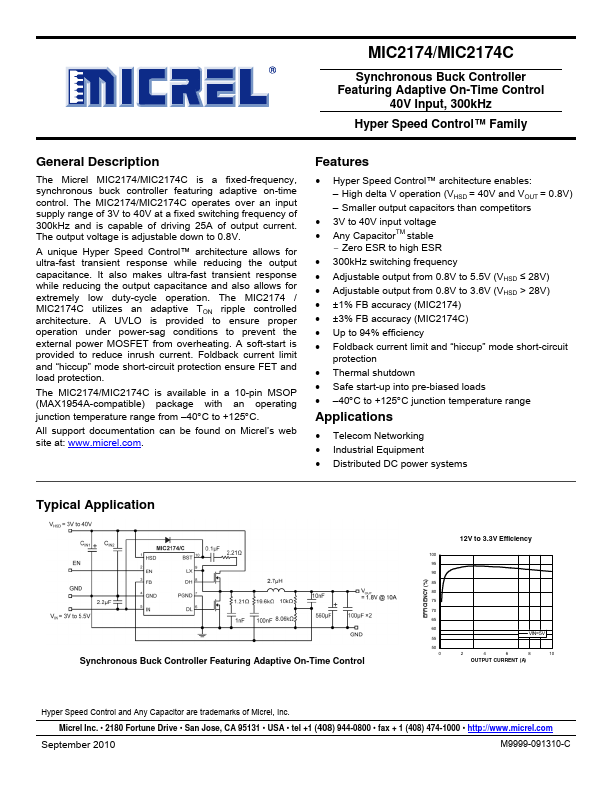
  • The Micrel MIC2174/MIC2174C is a fixed-frequency, synchronous buck controller featuring adaptive on-time control. The MIC2174/MIC2174C operates over an input supply range of 3V to 40V at a fixed switching frequency of 300kHz and is capable of driving 25A of output current. The output voltage is adjustable down to 0.8V. A unique Hyper Speed Controlâ„¢ architecture allows for ultra-fast transient response while reducing the output capacitance. It also makes ultra-fast transient response while reduc.

📥 Download Datasheet

Note: The manufacturer provides a single datasheet file (MIC2174_MicrelSemiconductor.pdf) that lists specifications for multiple related part numbers.

Datasheet Details

Part number MIC2174C
Manufacturer Micrel Semiconductor
File Size 621.25 KB
Description Synchronous Buck Controller
Datasheet download datasheet MIC2174C Datasheet

Full PDF Text Transcription (Reference)

The following content is an automatically extracted verbatim text from the original manufacturer datasheet and is provided for reference purposes only.

View original datasheet text
MIC2174/MIC2174C Synchronous Buck Controller Featuring Adaptive On-Time Control 40V Input, 300kHz Hyper Speed Controlâ„¢ Family General Description Features The Micrel MIC2174/MIC2174C is a fixed-frequency, synchronous buck controller featuring adaptive on-time control. The MIC2174/MIC2174C operates over an input supply range of 3V to 40V at a fixed switching frequency of 300kHz and is capable of driving 25A of output current. The output voltage is adjustable down to 0.8V. A unique Hyper Speed Controlâ„¢ architecture allows for ultra-fast transient response while reducing the output capacitance. It also makes ultra-fast transient response while reducing the output capacitance and also allows for extremely low duty-cycle operation.