MIC50399
MIC50399 is Six Decade Counter / Display Decoder manufactured by Micrel Semiconductor.
- Part of the MIC50398 comparator family.
- Part of the MIC50398 comparator family.
MIC50398/50399
Micrel
MIC50398/MIC50399
Six Decade Counter / Display Decoder
Not Remended for New Designs
General Description
Features
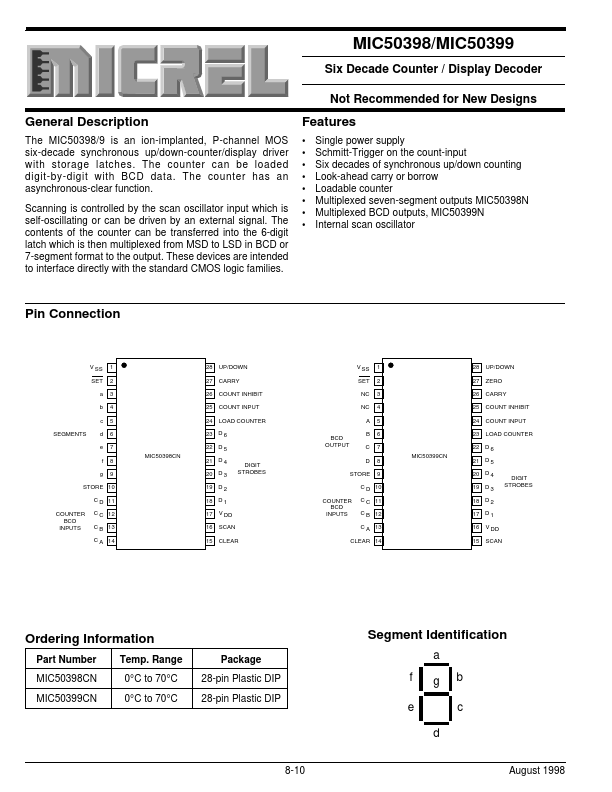
The MIC50398/9 is an ion-implanted, P-channel MOS six-decade synchronous up/down-counter/display driver with storage latches. The counter can be loaded digit-by-digit with BCD data. The counter has an asynchronous-clear function.
Scanning is controlled by the scan oscillator input which is self-oscillating or can be driven by an external signal. The contents of the counter can be transferred into the 6-digit latch which is then multiplexed from MSD to LSD in BCD or 7-segment format to the output. These devices are intended to interface directly with the standard CMOS logic families.
- Single power supply
- Schmitt-Trigger on the count-input
- Six decades of synchronous up/down counting
- Look-ahead carry or borrow
- Loadable counter
- Multiplexed seven-segment outputs MIC50398N
- Multiplexed BCD outputs, MIC50399N
- Internal...