Datasheet4U Logo Datasheet4U.com

MIC6211 - IttyBitty Operational Amplifier Preliminary Information

General Description

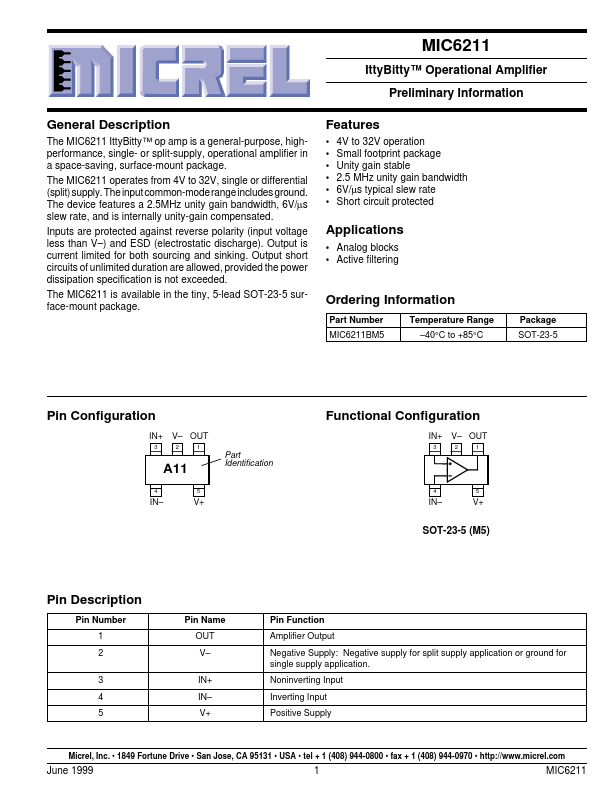
The MIC6211 IttyBitty™ op amp is a general-purpose, highperformance, single- or split-supply, operational amplifier in a space-saving, surface-mount package.

The MIC6211 operates from 4V to 32V, single or differential (split) supply.

The input common-mode range includes ground.

Key Features

  • a 2.5MHz unity gain bandwidth, 6V/µs slew rate, and is internally unity-gain compensated. Inputs are protected against reverse polarity (input voltage less than V.
  • ) and ESD (electrostatic discharge). Output is current limited for both sourcing and sinking. Output short circuits of unlimited duration are allowed, provided the power dissipation specification is not exceeded. The MIC6211 is available in the tiny, 5-lead SOT-23-5 surface-mount package. Features.

📥 Download Datasheet

Datasheet Details

Part number MIC6211
Manufacturer Micrel Semiconductor
File Size 137.29 KB
Description IttyBitty Operational Amplifier Preliminary Information
Datasheet download datasheet MIC6211 Datasheet

Full PDF Text Transcription (Reference)

The following content is an automatically extracted verbatim text from the original manufacturer datasheet and is provided for reference purposes only.

View original datasheet text
MIC6211 Micrel MIC6211 IttyBitty™ Operational Amplifier Preliminary Information General Description The MIC6211 IttyBitty™ op amp is a general-purpose, highperformance, single- or split-supply, operational amplifier in a space-saving, surface-mount package. The MIC6211 operates from 4V to 32V, single or differential (split) supply. The input common-mode range includes ground. The device features a 2.5MHz unity gain bandwidth, 6V/µs slew rate, and is internally unity-gain compensated. Inputs are protected against reverse polarity (input voltage less than V–) and ESD (electrostatic discharge). Output is current limited for both sourcing and sinking. Output short circuits of unlimited duration are allowed, provided the power dissipation specification is not exceeded.