Datasheet4U Logo Datasheet4U.com

LX1562 - SECOND-GENERATION POWER FACTOR CONTROLLER

Download the LX1562 datasheet PDF. This datasheet also covers the LX1 variant, as both devices belong to the same second-generation power factor controller family and are provided as variant models within a single manufacturer datasheet.

General Description

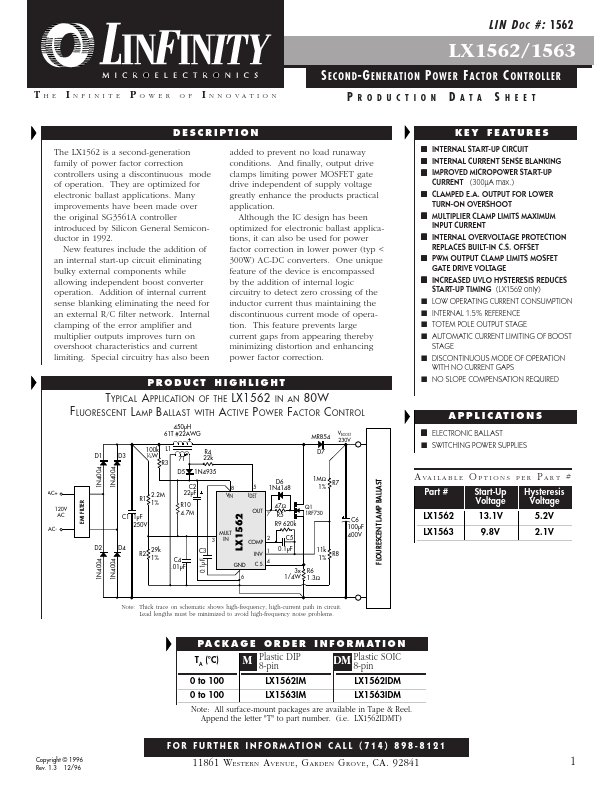
The LX1562 is a second-generation family of power factor correction controllers using a discontinuous mode of operation.

They are optimized for electronic ballast applications.

Many improvements have been made over the original SG3561A controller introduced by Silicon General Semiconductor in 1992.

Key Features

  • include the addition of an internal start-up circuit eliminating bulky external components while allowing independent boost converter operation. Addition of internal current sense blanking eliminating the need for an external R/C filter network. Internal clamping of the error amplifier and multiplier outputs improves turn on overshoot characteristics and current limiting. Special circuitry has also been added to prevent no load runaway conditions. And finally, output drive clamps limiting power.

📥 Download Datasheet

Note: The manufacturer provides a single datasheet file (LX1-562.pdf) that lists specifications for multiple related part numbers.

Full PDF Text Transcription (Reference)

The following content is an automatically extracted verbatim text from the original manufacturer datasheet and is provided for reference purposes only.

View original datasheet text
L I N D O C # : 1562 LX1562/1563 S E C O N D -G E N E R AT I O N P O W E R F A C T O R C O N T R O L L E R T H E I N F I N I T E P O W E R O F I N N O VA T I O N P R O D U C T I O N D A T A S H E E T DESCRIPTION The LX1562 is a second-generation family of power factor correction controllers using a discontinuous mode of operation. They are optimized for electronic ballast applications. Many improvements have been made over the original SG3561A controller introduced by Silicon General Semiconductor in 1992. New features include the addition of an internal start-up circuit eliminating bulky external components while allowing independent boost converter operation. Addition of internal current sense blanking eliminating the need for an external R/C filter network.