Datasheet4U Logo Datasheet4U.com

SG1527A - Regulating Pulse Width Modulator

Download the SG1527A datasheet PDF. This datasheet also covers the SG1525A variant, as both devices belong to the same regulating pulse width modulator family and are provided as variant models within a single manufacturer datasheet.

General Description

The SG1525A/1527A series of pulse width modulator integrated circuits are designed to offer improved performance and lower external parts count when used to implement all types of switching power supplies.

Key Features

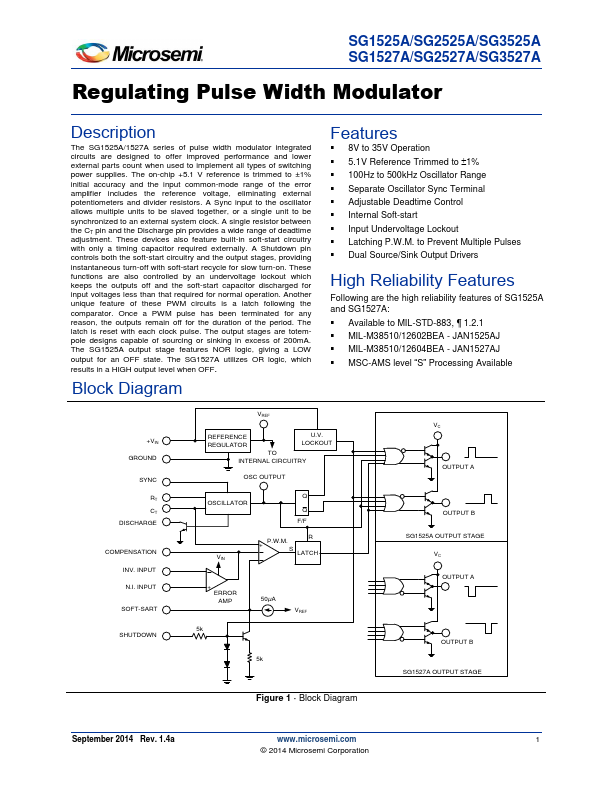
  • NOR logic, giving a LOW output for an OFF state. The SG1527A utilizes OR logic, which results in a HIGH output level when OFF. Block Diagram Features.
  • 8V to 35V Operation.
  • 5.1V Reference Trimmed to 1%.
  • 100Hz to 500kHz Oscillator Range.
  • Separate Oscillator Sync Terminal.
  • Adjustable Deadtime Control.
  • Internal Soft-start.
  • Input Undervoltage Lockout.
  • Latching P. W. M. to Prevent Multiple Pulses.
  • Dual Source/Sink Output Drivers High Reliability Features Fo.

📥 Download Datasheet

Note: The manufacturer provides a single datasheet file (SG1525A-Microsemi.pdf) that lists specifications for multiple related part numbers.

Full PDF Text Transcription (Reference)

The following content is an automatically extracted verbatim text from the original manufacturer datasheet and is provided for reference purposes only.

View original datasheet text
SG1525A/SG2525A/SG3525A SG1527A/SG2527A/SG3527A Regulating Pulse Width Modulator Description The SG1525A/1527A series of pulse width modulator integrated circuits are designed to offer improved performance and lower external parts count when used to implement all types of switching power supplies. The on-chip +5.1 V reference is trimmed to ±1% initial accuracy and the input common-mode range of the error amplifier includes the reference voltage, eliminating external potentiometers and divider resistors. A Sync input to the oscillator allows multiple units to be slaved together, or a single unit to be synchronized to an external system clock. A single resistor between the CT pin and the Discharge pin provides a wide range of deadtime adjustment.