

Datasheet4U Logo Datasheet4U.com

GHP2815S - HYBRID-HIGH RELIABILITY RADIATION HARDENED DC-DC CONVERTER

This page provides the datasheet information for the GHP2815S, a member of the GHP2805S HYBRID-HIGH RELIABILITY RADIATION HARDENED DC-DC CONVERTER family.

Datasheet Summary

Description

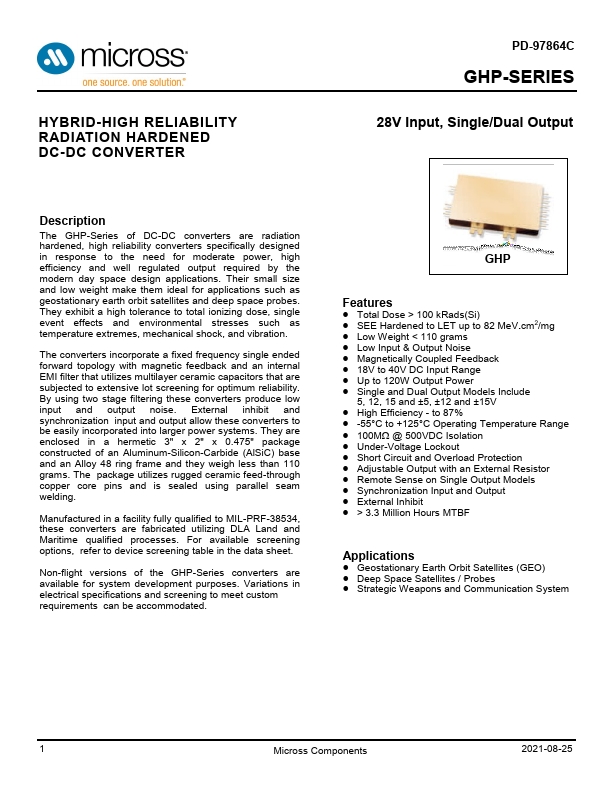
The GHP-Series of DC-DC converters are radiation hardened, high reliability converters specifically designed in response to the need for moderate power, high efficiency and well regulated output required by the modern day space design applications.

Features

  • Total Dose > 100 kRads(Si).
  • SEE Hardened to LET up to 82 MeV. cm2/mg.
  • Low Weight < 110 grams.
  • Low Input & Output Noise.
  • Magnetically Coupled Feedback.
  • 18V to 40V DC Input Range.
  • Up to 120W Output Power.
  • Single and Dual Output Models Include 5, 12, 15 and ±5, ±12 and ±15V.
  • High Efficiency - to 87%.
  • -55°C to +125°C Operating Temperature Range.
  • 100M @ 500VDC Isolation.
  • Under-Voltage Lockout.
  • Short Circuit and Overload Protection.

📥 Download Datasheet

Datasheet preview – GHP2815S

Datasheet Details

Part number GHP2815S
Manufacturer Micross
File Size 1.44 MB
Description HYBRID-HIGH RELIABILITY RADIATION HARDENED DC-DC CONVERTER
Datasheet download datasheet GHP2815S Datasheet
Additional preview pages of the GHP2815S datasheet.
Other Datasheets by Micross

Full PDF Text Transcription

Click to expand full text
HYBRID-HIGH RELIABILITY RADIATION HARDENED DC-DC CONVERTER PD-97864C GHP-SERIES 28V Input, Single/Dual Output Description The GHP-Series of DC-DC converters are radiation hardened, high reliability converters specifically designed in response to the need for moderate power, high efficiency and well regulated output required by the modern day space design applications. Their small size and low weight make them ideal for applications such as geostationary earth orbit satellites and deep space probes. They exhibit a high tolerance to total ionizing dose, single event effects and environmental stresses such as temperature extremes, mechanical shock, and vibration.
Published: |