XU1001
XU1001 is GaAs MMIC Transmitter manufactured by Mimix Broadband.
Features
Sub-Harmonic Transmitter Low DC Power Consumption Optional Power Bias 8.0 d B Conversion Gain 30 d B LO/RF Isolation 100% On-Wafer RF and DC Testing 100% Visual Inspection to MIL-STD-883 Method 2010
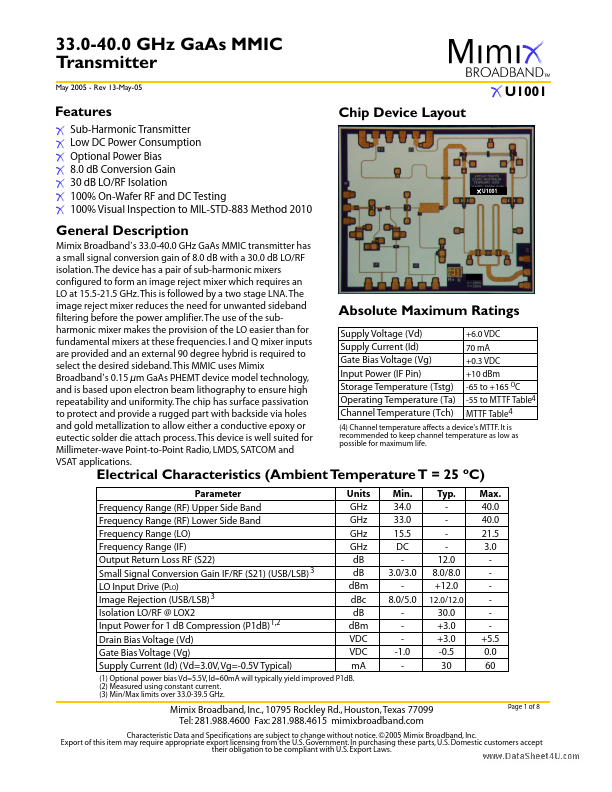
Mimix Broadband’s 33.0-40.0 GHz Ga As MMIC transmitter has a small signal conversion gain of 8.0 d B with a 30.0 d B LO/RF isolation. The device has a pair of sub-harmonic mixers configured to form an image reject mixer which requires an LO at 15.5-21.5 GHz. This is followed by a two stage LNA. The image reject mixer reduces the need for unwanted sideband filtering before the power amplifier. The use of the subharmonic mixer makes the provision of the LO easier than for fundamental mixers at these frequencies. I and Q mixer inputs are provided and an external 90 degree hybrid is required to select the desired sideband. This MMIC uses Mimix Broadband’s 0.15 µm Ga As PHEMT device model technology, and is based upon electron beam lithography to ensure high repeatability and uniformity. The chip has surface passivation to protect and provide a rugged part with backside via holes and gold metallization to allow either a conductive epoxy or eutectic solder die attach process. This device is well suited for Millimeter-wave Point-to-Point Radio, LMDS, SAT and VSAT applications.
U1001
General Description
Absolute Maximum Ratings
Supply Voltage (Vd) Supply Current (Id) Gate Bias Voltage (Vg) Input Power (IF Pin) Storage Temperature (Tstg) Operating Temperature (Ta) Channel Temperature (Tch)
+6.0 VDC 70 m A +0.3 VDC +10 d Bm -65 to +165 OC -55 to MTTF Table4 MTTF Table4
(4) Channel temperature affects a device's MTTF. It is remended to keep channel temperature as low as possible for maximum life.
Electrical Characteristics (Ambient Temperature T = 25 o C)
Parameter Frequency Range (RF) Upper Side Band Frequency Range (RF) Lower Side Band Frequency Range (LO) Frequency Range (IF) Output Return Loss RF (S22) Small Signal Conversion Gain IF/RF (S21) (USB/LSB) 3 LO Input Drive...