GVA-81+
GVA-81+ is Monolithic Amplifier manufactured by Mini-Circuits.
- Part of the GVA-81+-Mini comparator family.
- Part of the GVA-81+-Mini comparator family.
5 VOLT-SURFACE MOUNT
Monolithic Amplifier
50Ω DC to 6 GHz
THE BIG DEAL y Gain, 10 d B typ. y High Pout, P1d B 19.5 d Bm typ. y High IP3, 41 d Bm typ. at 1 GHz y Ruggedized design y Fixed 5V operation y Unconditionally stable y Excellent ESD Protection y Transient protected, US patent 6,943,629 y Low additive phase noise, typically -171 d Bc/Hz @10 KHz
APPLICATIONS y Base station infrastructure y Portable Wireless y CATV & DBS y MMDS & Wireless LAN y LTE y Suitable for low phase noise applications
Generic photo used for illustration purposes only CASE STYLE: DF782
+Ro HS pliant
The +Suffix identifies Ro HS pliance. See our web site for Ro HS pliance methodologies and qualifications
LTE Performance
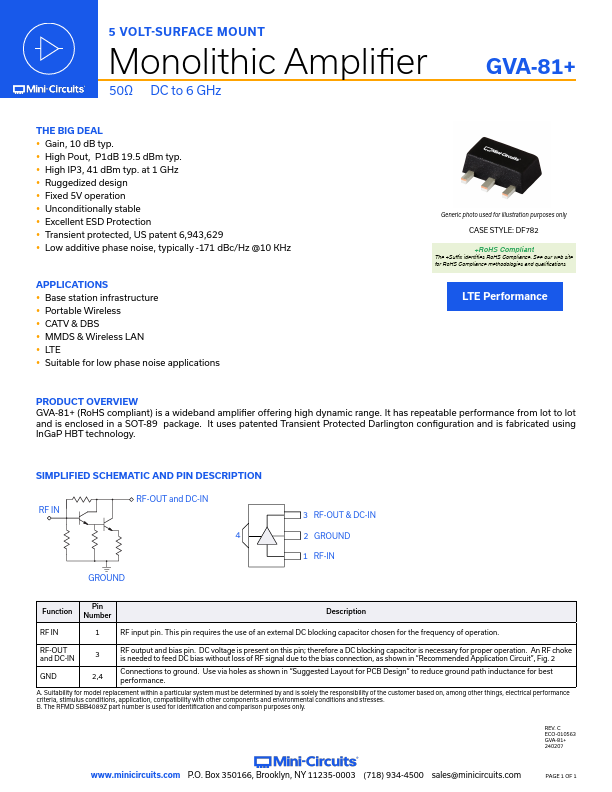
PRODUCT OVERVIEW GVA-81+ (Ro HS pliant) is a wideband amplifier offering high dynamic range. It has repeatable performance from lot to lot and is enclosed in a SOT-89 package. It uses patented Transient Protected Darlington configuration and is fabricated using In Ga P HBT technology.
SIMPLIFIED SCHEMATIC AND PIN DESCRIPTION
RF IN
RF-OUT and DC-IN
GROUND
3 RF-OUT & DC-IN 2 GROUND 1 RF-IN
Function
Pin Number
Description
RF IN
RF input pin. This pin requires the use of an external DC blocking capacitor chosen for the frequency of operation.
RF-OUT and DC-IN
RF output and bias pin. DC voltage is present on this pin; therefore a DC blocking capacitor is necessary for proper operation. An RF choke is needed to feed DC bias without loss of RF signal due to the bias connection, as shown in “Remended Application Circuit”, Fig. 2
2,4
Connections to ground. Use via holes as shown in “Suggested Layout for PCB Design” to reduce ground path inductance for best performance.
A. Suitability for model replacement within a particular system must be determined by and is solely the responsibility of the customer based on, among other things, electrical performance criteria, stimulus conditions, application, patibility with other ponents and...