KSN-2025A+
KSN-2025A+ is Frequency Synthesizer manufactured by Mini-Circuits.
- Part of the KSN-2025A_Mini comparator family.
- Part of the KSN-2025A_Mini comparator family.
..net
Frequency Synthesizer
50Ω 2010 to 2025 MHz
The Big Deal
- Fractional N synthesizer
- Low phase noise and spurious
- Robust design and construction
- Small size 0.80" x 0.58" x 0.15"
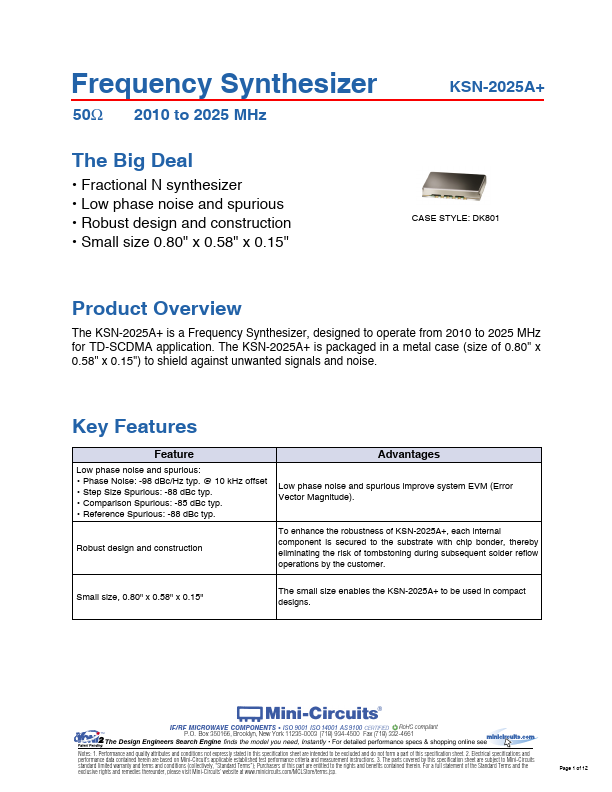
CASE STYLE: DK801
Product Overview
The KSN-2025A+ is a Frequency Synthesizer, designed to operate from 2010 to 2025 MHz for TD-SCDMA application. The KSN-2025A+ is packaged in a metal case (size of 0.80" x 0.58" x 0.15") to shield against unwanted signals and noise.
Key Features
Feature
Low phase noise and spurious:
- Phase Noise: -98 d Bc/Hz typ. @ 10 k Hz offset
- Step Size Spurious: -88 d Bc typ.
- parison Spurious: -85 d Bc typ.
- Reference Spurious: -88 d Bc typ.
Advantages
Low phase noise and spurious improve system EVM (Error Vector Magnitude).
Robust design and construction
To enhance the robustness of KSN-2025A+, each internal ponent is secured to the substrate with chip bonder, thereby eliminating the risk of tombstoning during subsequent solder reflow operations by the customer. The small size enables the KSN-2025A+ to be used in pact designs.
Small size, 0.80" x 0.58" x 0.15"
®
Ro HS pliant IF/RF MICROWAVE PONENTS-
- -
- -
- 9001 ISO 14001 AS 9100 CERTIFIED P.O. Box 350166, Brooklyn, New York 11235-0003 (718) 934-4500 Fax (718) 332-4661 o
The Design Engineers Search Engine finds the model you need, Instantly
- For detailed performance specs & shopping online...