Datasheet4U Logo Datasheet4U.com

MM3092G - Low-Saturation CMOS Regulators

Download the MM3092G datasheet PDF (MM309x included). The manufacturer datasheet provides complete specifications, pinout details, electrical characteristics, and typical applications for low-saturation cmos regulators.

Description

Pin No.

pin, when it is not used.

Pin No.

Features

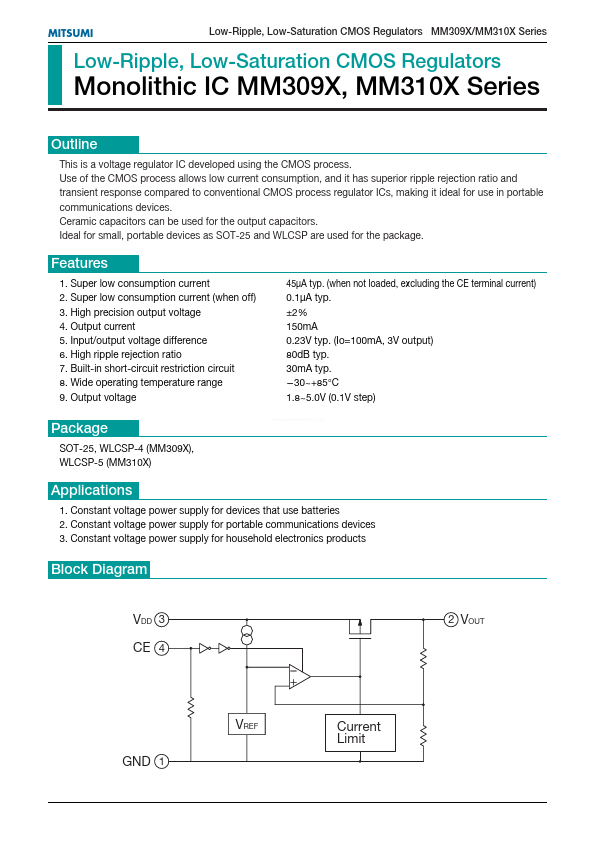
  • 1. Super low consumption current 2. Super low consumption current (when off) 3. High precision output voltage 4. Output current 5. Input/output voltage difference 6. High ripple rejection ratio 7. Built-in short-circuit restriction circuit 8. Wide operating temperature range 9. Output voltage 45µA typ. (when not loaded, excluding the CE terminal current) 0.1µA typ. ±2% 150mA 0.23V typ. (Io=100mA, 3V output) 80dB typ. 30mA typ. -30~+85°C 1.8~5.0V (0.1V step) Package SOT-25, WLCSP-4 (MM309X), WL.

📥 Download Datasheet

Note: The manufacturer provides a single datasheet file (MM309x_MitsumiElectronics.pdf) that lists specifications for multiple related part numbers.

Datasheet Details

Part number MM3092G
Manufacturer Mitsumi Electronics
File Size 122.76 KB
Description Low-Saturation CMOS Regulators
Datasheet download datasheet MM3092G Datasheet
Other Datasheets by Mitsumi Electronics

Full PDF Text Transcription

Click to expand full text
MITSUMI Low-Ripple, Low-Saturation CMOS Regulators MM309X/MM310X Series Low-Ripple, Low-Saturation CMOS Regulators Monolithic IC MM309X, MM310X Series Outline This is a voltage regulator IC developed using the CMOS process. Use of the CMOS process allows low current consumption, and it has superior ripple rejection ratio and transient response compared to conventional CMOS process regulator ICs, making it ideal for use in portable communications devices. Ceramic capacitors can be used for the output capacitors. Ideal for small, portable devices as SOT-25 and WLCSP are used for the package. Features 1. Super low consumption current 2. Super low consumption current (when off) 3. High precision output voltage 4. Output current 5. Input/output voltage difference 6.
Published: |