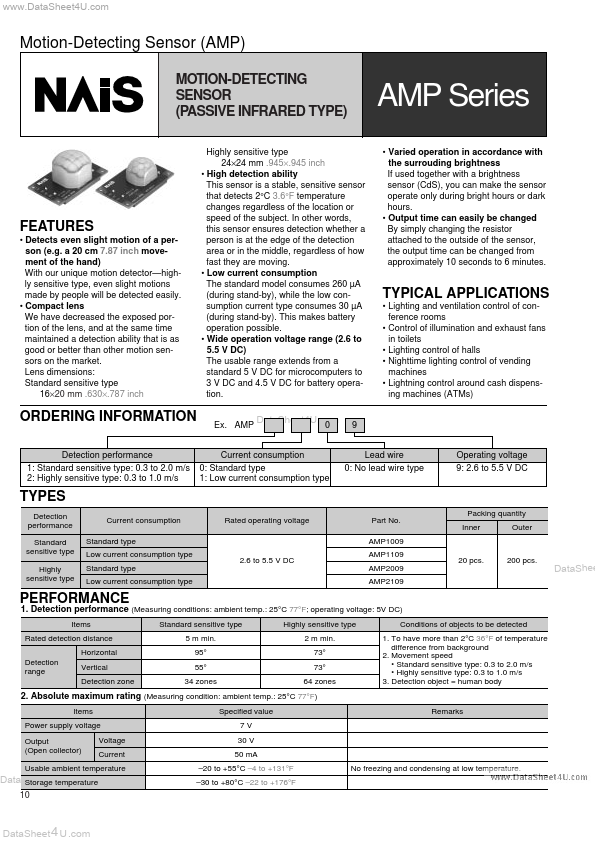
AMP2109
AMP2109 is (AMPxx09) Motion Detecting Sensor manufactured by NAIS.
- Part of the AMP2009 comparator family.
- Part of the AMP2009 comparator family.
..
Motion-Detecting Sensor (AMP)
MOTION-DETECTING SENSOR (PASSIVE INFRARED TYPE)
Highly sensitive type 24×24 mm .945×.945 inch
- High detection ability This sensor is a stable, sensitive sensor that detects 2°C 3.6°F temperature changes regardless of the location or speed of the subject. In other words, this sensor ensures detection whether a person is at the edge of the detection area or in the middle, regardless of how fast they are moving.
- Low current consumption The standard model consumes 260 µA (during stand-by), while the low consumption current type consumes 30 µA (during stand-by). This makes battery operation possible.
- Wide operation voltage range (2.6 to 5.5 V DC) The usable range extends from a standard 5 V DC for microputers to 3 V DC and 4.5 V DC for battery operation. Ex. AMP . 0 Current consumption 0: Standard type 1: Low current consumption type 9 Lead wire 0: No lead wire type Operating voltage 9: 2.6 to 5.5 V DC
AMP Series
- Varied operation in accordance with the surrouding brightness If used together with a brightness sensor (Cd S), you can make the sensor operate only during bright hours or dark hours.
- Output time can easily be changed By simply changing the resistor attached to the outside of the sensor, the output time can be changed from approximately 10 seconds to 6 minutes.
Features
- Detects even slight motion of a person (e.g. a 20 cm 7.87 inch movement of the hand) With our unique motion detector- highly sensitive type, even slight motions made by people will be detected easily.
- pact lens We have decreased the exposed portion of the lens, and at the same time maintained a detection ability that is as good or better than other motion sensors on the market. Lens dimensions: Standard sensitive type 16×20 mm .630×.787 inch
TYPICAL APPLICATIONS
- Lighting and ventilation control of conference rooms
- Control of illumination and exhaust fans in toilets
- Lighting control of halls
- Nighttime...