LD7111
LD7111 is HIGH POWER KLYSTRON manufactured by NEC.
DATA S H E E T
HIGH POWER KLYSTRON FOR GROUND TERMINALS
LD7111 SERIES
17 GHz BAND, 1.7 k W, HIGH EFICIENCY, HIGH POWER GAIN
GENERAL DESCRIPTION
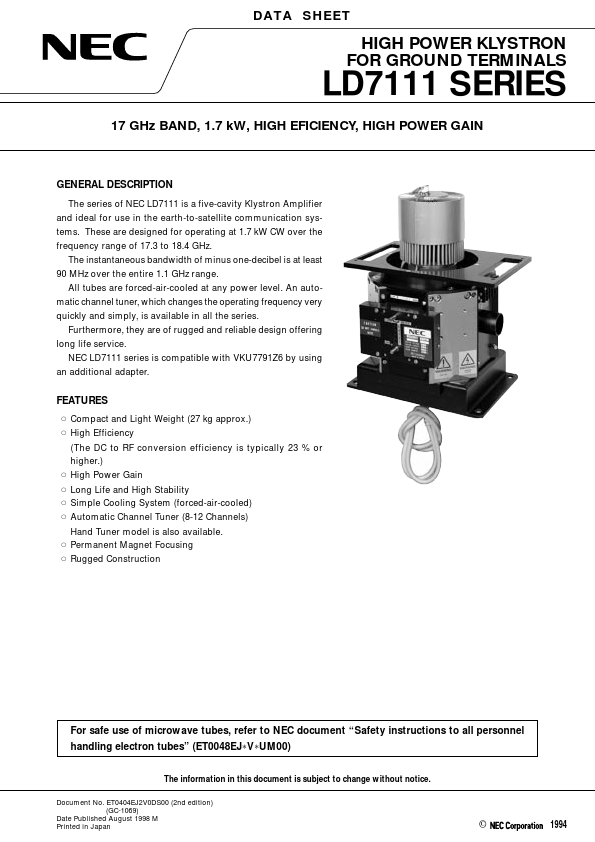
The series of NEC LD7111 is a five-cavity Klystron Amplifier and ideal for use in the earth-to-satellite munication systems. These are designed for operating at 1.7 k W CW over the frequency range of 17.3 to 18.4 GHz. The instantaneous bandwidth of minus one-decibel is at least 90 MHz over the entire 1.1 GHz range. All tubes are forced-air-cooled at any power level. An automatic channel tuner, which changes the operating frequency very quickly and simply, is available in all the series. Furthermore, they are of rugged and reliable design offering long life service. NEC LD7111 series is patible with VKU7791Z6 by using an additional adapter.
Features
™ pact and Light Weight (27 kg approx.) ™ High Efficiency (The DC to RF conversion efficiency is typically 23 % or higher.) ™ High Power Gain ™ Long Life and High Stability ™ Simple Cooling System (forced-air-cooled) ™ Automatic Channel Tuner (8-12 Channels) Hand Tuner model is also available. ™ Permanent Magnet Focusing ™ Rugged Construction
For safe use of microwave tubes, refer to NEC document “Safety instructions to all personnel handling electron tubes” (ET0048EJ∗V∗UM00)
The information in this document is subject to change without notice.
Document No. ET0404EJ2V0DS00 (2nd edition) (GC-1069) Date Published August 1998 M Printed in Japan
©
LD7111 SERIES
GENERAL CHARACTERISTICS
ELECTRICAL Frequency ……………………………………………… Output Power ………………………………………… Heater Voltage ………………………………………… Heater Current ………………………………………… Cathode Type ………………………………………… Cathode Warm-up Time …………………………… MECHANICAL Dimensions …………………………………………… Weight ………………………………………………… Focusing ……………………………………………… Mounting Position …………………………………… Cooling ………………………………………………… Electrical Connections ……………………………… RF Connections Input ………………………………………………… Output ……………………………………………… Cavity Tuning Method...