Datasheet4U Logo Datasheet4U.com

UPD4482363 - (UPD4482163/2183/2323/2363) 8M-BIT CMOS SYNCHRONOUS FAST SRAM

This page provides the datasheet information for the UPD4482363, a member of the UPD4482163 (UPD4482163/2183/2323/2363) 8M-BIT CMOS SYNCHRONOUS FAST SRAM family.

Datasheet Summary

Description

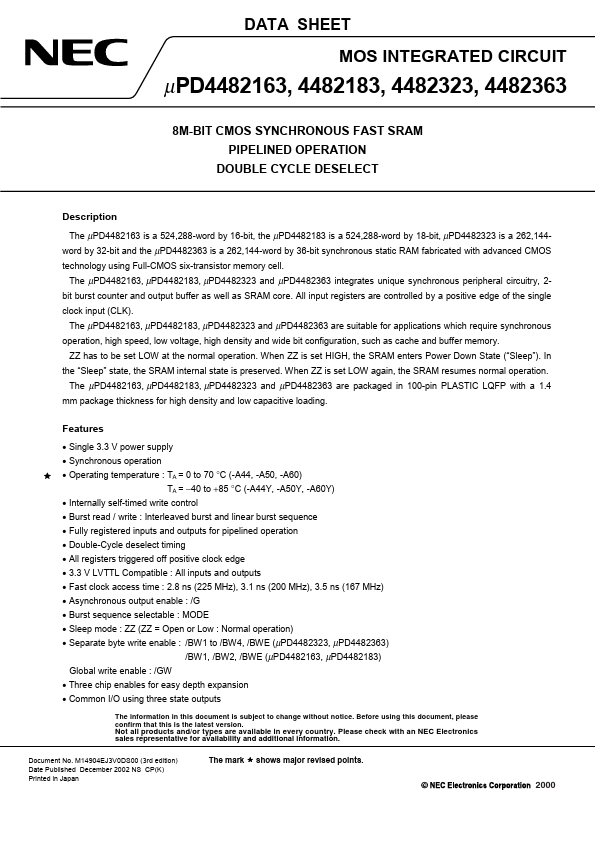
The µPD4482163 is a 524,288-word by 16-bit, the µPD4482183 is a 524,288-word by 18-bit, µPD4482323 is a 262,144word by 32-bit and the µPD4482363 is a 262,144-word by 36-bit synchronous static RAM fabricated with advanced CMOS technology using Full-CMOS six-transistor memory cell.

Features

  • Single 3.3 V power supply.
  • Synchronous operation.
  • Operating temperature : TA = 0 to 70 °C (-A44, -A50, -A60) TA =.
  • 40 to +85 °C (-A44Y, -A50Y, -A60Y).
  • Internally self-timed write control.
  • Burst read / write : Interleaved burst and linear burst sequence.
  • Fully registered inputs and outputs for pipelined operation.
  • Double-Cycle deselect timing.
  • All registers triggered off positive clock edge.
  • 3.3 V LVTTL Comp.

📥 Download Datasheet

Datasheet preview – UPD4482363

Datasheet Details

Part number UPD4482363
Manufacturer NEC
File Size 300.53 KB
Description (UPD4482163/2183/2323/2363) 8M-BIT CMOS SYNCHRONOUS FAST SRAM
Datasheet download datasheet UPD4482363 Datasheet
Additional preview pages of the UPD4482363 datasheet.
Other Datasheets by NEC

Full PDF Text Transcription

Click to expand full text
DATA SHEET MOS INTEGRATED CIRCUIT µPD4482163, 4482183, 4482323, 4482363 8M-BIT CMOS SYNCHRONOUS FAST SRAM PIPELINED OPERATION DOUBLE CYCLE DESELECT Description The µPD4482163 is a 524,288-word by 16-bit, the µPD4482183 is a 524,288-word by 18-bit, µPD4482323 is a 262,144word by 32-bit and the µPD4482363 is a 262,144-word by 36-bit synchronous static RAM fabricated with advanced CMOS technology using Full-CMOS six-transistor memory cell. The µPD4482163, µPD4482183, µPD4482323 and µPD4482363 integrates unique synchronous peripheral circuitry, 2bit burst counter and output buffer as well as SRAM core. All input registers are controlled by a positive edge of the single clock input (CLK).
Published: |