Datasheet4U Logo Datasheet4U.com

UPD70208H - 16-BIT MICROPROCESSOR

Download the UPD70208H datasheet PDF. This datasheet also covers the UPD variant, as both devices belong to the same 16-bit microprocessor family and are provided as variant models within a single manufacturer datasheet.

General Description

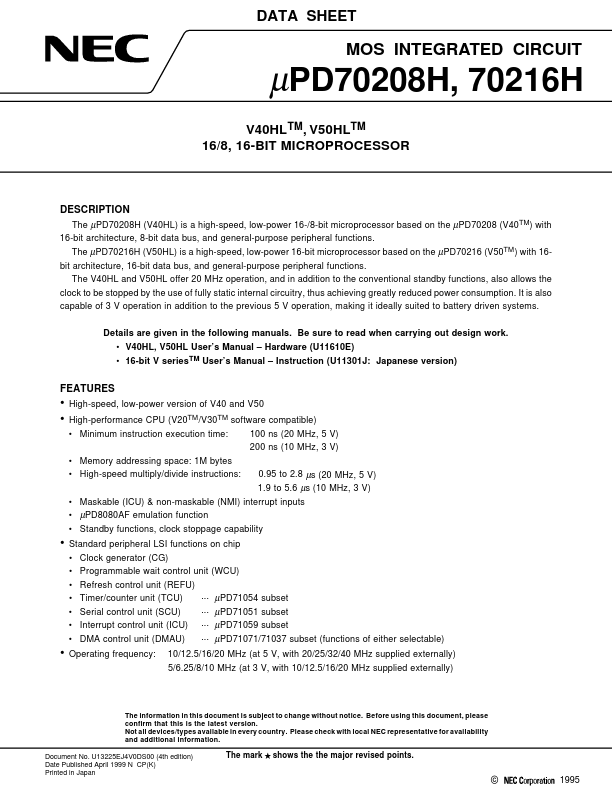
The µ PD70208H (V40HL) is a high-speed, low-power 16-/8-bit microprocessor based on the µ PD70208 (V40TM) with 16-bit architecture, 8-bit data bus, and general-purpose peripheral functions.

Key Features

  • High-speed, low-power version of V40 and V50 High-performance CPU (V20TM /V30TM software compatible).
  • Minimum instruction execution time:.
  • Memory addressing space: 1M bytes.
  • High-speed multiply/divide instructions: 100 ns (20 MHz, 5 V) 200 ns (10 MHz, 3 V) 0.95 to 2.8 µs (20 MHz, 5 V) 1.9 to 5.6 µs (10 MHz, 3 V).
  • Maskable (ICU) & non-maskable (NMI) interrupt inputs.
  • µPD8080AF emulation function.
  • Standby functions, clock.

📥 Download Datasheet

Note: The manufacturer provides a single datasheet file (UPD-7020.pdf) that lists specifications for multiple related part numbers.

Full PDF Text Transcription (Reference)

The following content is an automatically extracted verbatim text from the original manufacturer datasheet and is provided for reference purposes only.

View original datasheet text
DATA SHEET µPD70208H, 70216H V40HLTM, V50HLTM 16/8, 16-BIT MICROPROCESSOR MOS INTEGRATED CIRCUIT DESCRIPTION The µ PD70208H (V40HL) is a high-speed, low-power 16-/8-bit microprocessor based on the µ PD70208 (V40TM) with 16-bit architecture, 8-bit data bus, and general-purpose peripheral functions. The µ PD70216H (V50HL) is a high-speed, low-power 16-bit microprocessor based on the µ PD70216 (V50TM ) with 16bit architecture, 16-bit data bus, and general-purpose peripheral functions. The V40HL and V50HL offer 20 MHz operation, and in addition to the conventional standby functions, also allows the clock to be stopped by the use of fully static internal circuitry, thus achieving greatly reduced power consumption.