

Datasheet4U Logo Datasheet4U.com

BLM6G10-30G - W-CDMA 900 MHz - 1000 MHz power MMIC

This page provides the datasheet information for the BLM6G10-30G, a member of the BLM6G10-30 W-CDMA 900 MHz - 1000 MHz power MMIC family.

Datasheet Summary

Description

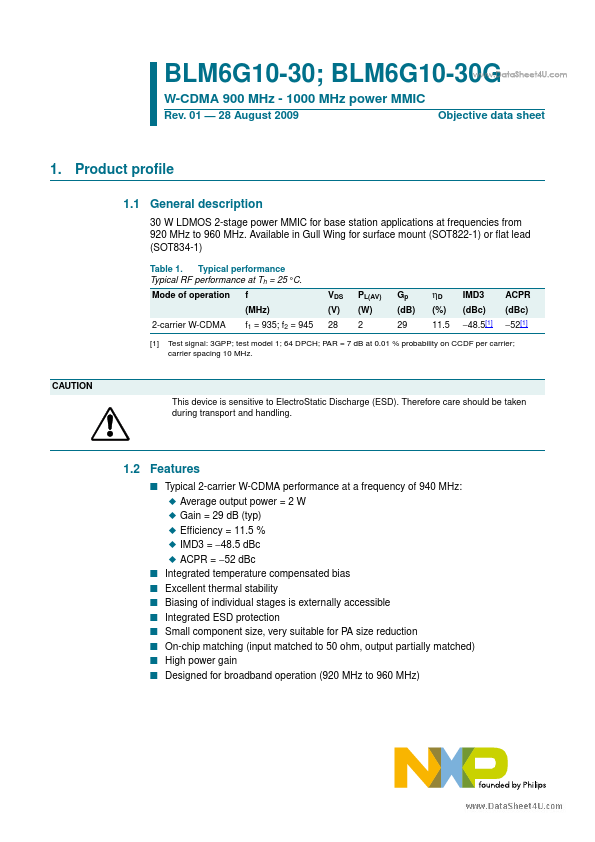
30 W LDMOS 2-stage power MMIC for base station applications at frequencies from 920 MHz to 960 MHz.

Table 1.

Typical performance Typical RF performance at Th = 25 °C.

Features

  • I Typical 2-carrier W-CDMA performance at a frequency of 940 MHz: N Average output power = 2 W N Gain = 29 dB (typ) N Efficiency = 11.5 % N IMD3 =.
  • 48.5 dBc N ACPR =.
  • 52 dBc I Integrated temperature compensated bias I Excellent thermal stability I Biasing of individual stages is externally accessible I Integrated ESD protection I Small component size, very suitable for PA size reduction I On-chip matching (input matched to 50 ohm, output partially matched) I High power gain I Desi.

📥 Download Datasheet

Datasheet preview – BLM6G10-30G

Datasheet Details

Part number BLM6G10-30G
Manufacturer NXP Semiconductors
File Size 109.37 KB
Description W-CDMA 900 MHz - 1000 MHz power MMIC
Datasheet download datasheet BLM6G10-30G Datasheet
Additional preview pages of the BLM6G10-30G datasheet.
Other Datasheets by NXP Semiconductors

Full PDF Text Transcription

Click to expand full text
BLM6G10-30; BLM6G10-30G W-CDMA 900 MHz - 1000 MHz power MMIC Rev. 01 — 28 August 2009 www.DataSheet4U.com Objective data sheet 1. Product profile 1.1 General description 30 W LDMOS 2-stage power MMIC for base station applications at frequencies from 920 MHz to 960 MHz. Available in Gull Wing for surface mount (SOT822-1) or flat lead (SOT834-1) Table 1. Typical performance Typical RF performance at Th = 25 °C. Mode of operation 2-carrier W-CDMA [1] f (MHz) f1 = 935; f2 = 945 VDS (V) 28 PL(AV) (W) 2 Gp (dB) 29 ηD (%) 11.5 IMD3 (dBc) −48.5[1] ACPR (dBc) −52[1] Test signal: 3GPP; test model 1; 64 DPCH; PAR = 7 dB at 0.01 % probability on CCDF per carrier; carrier spacing 10 MHz. CAUTION This device is sensitive to ElectroStatic Discharge (ESD).
Published: |