Datasheet4U Logo Datasheet4U.com

74HCT154 - 4-to-16 line decoder/demultiplexer

Download the 74HCT154 datasheet PDF. This datasheet also covers the 74HC154 variant, as both devices belong to the same 4-to-16 line decoder/demultiplexer family and are provided as variant models within a single manufacturer datasheet.

General Description

The 74HC154; 74HCT154 is a 4-to-16 line decoder/demultiplexer.

It decodes four binary weighted address inputs (A0 to A3) to sixteen mutually exclusive outputs (Y0 to Y15).

Key Features

  • 16-line demultiplexing capability.
  • Decodes 4 binary-coded inputs into 16 mutually-exclusive outputs.
  • Complies with JEDEC standard no. 7A.
  • Input levels:.
  • For 74HC154: CMOS level.
  • For 74HCT154: TTL level.
  • ESD protection:.
  • HBM JESD22-A114F exceeds 2000 V.
  • MM JESD22-A115-A exceeds 200 V.
  • Multiple package options.
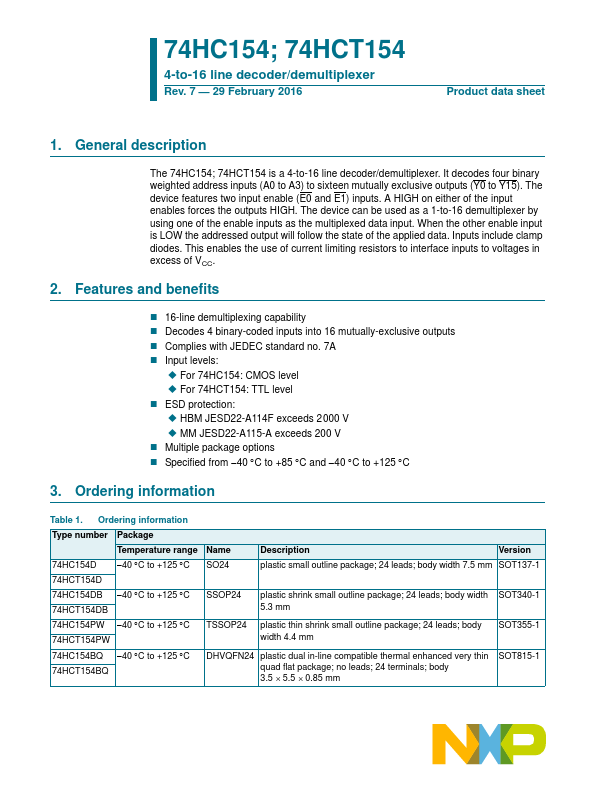
  • Specified from 40 C to +85 C and 40 C to +125 C 3. Ordering information Table 1. Ordering information Type number Package T.

📥 Download Datasheet

Note: The manufacturer provides a single datasheet file (74HC154-NXP.pdf) that lists specifications for multiple related part numbers.

Full PDF Text Transcription (Reference)

The following content is an automatically extracted verbatim text from the original manufacturer datasheet and is provided for reference purposes only.

View original datasheet text
74HC154; 74HCT154 4-to-16 line decoder/demultiplexer Rev. 7 — 29 February 2016 Product data sheet 1. General description The 74HC154; 74HCT154 is a 4-to-16 line decoder/demultiplexer. It decodes four binary weighted address inputs (A0 to A3) to sixteen mutually exclusive outputs (Y0 to Y15). The device features two input enable (E0 and E1) inputs. A HIGH on either of the input enables forces the outputs HIGH. The device can be used as a 1-to-16 demultiplexer by using one of the enable inputs as the multiplexed data input. When the other enable input is LOW the addressed output will follow the state of the applied data. Inputs include clamp diodes. This enables the use of current limiting resistors to interface inputs to voltages in excess of VCC. 2.