A3M36SL037S
A3M36SL037S is Airfast Power Amplifier manufactured by NXP Semiconductors.
- Part of the A3M36SL037 comparator family.
- Part of the A3M36SL037 comparator family.
feature with the option to overwrite production settings. Autobias automatically sets and regulates transistor bias over temperature upon power up. An integrated sensor for monitoring temperature is also present. munications to the module can be acplished via either I2C or SPI.
3400- 3800 MHz
Typical LTE Performance: Pout = 5 W Avg., VDD = 27 Vdc, 1 × 20 MHz LTE, Input Signal PAR = 8 d B @ 0.01% Probability on CCDF.1
Carrier Center Frequency
Gain (d B)
ACPR (d Bc)
PAE (%)
3410 MHz
- 29.1
3600 MHz
- 35.6
3790 MHz
- 33.6
1. All data measured with device soldered in NXP reference circuit.
Features
- Advanced high performance in-package Doherty
- Fully matched (50 ohm input/output, DC blocked)
- Designed for low plexity digital linearization systems
- Autobias on power up
- Temperature sensing
- Digital interface (I2C or SPI)
- Embedded registers and DACs for setting bias conditions
- Tx Enable control pin for TDD operation
A3M36SL037I A3M36SL037S 3400- 3800 MHz, 29 d B, 5 W Avg. Airfast Power Amplifier Module with Autobias Control
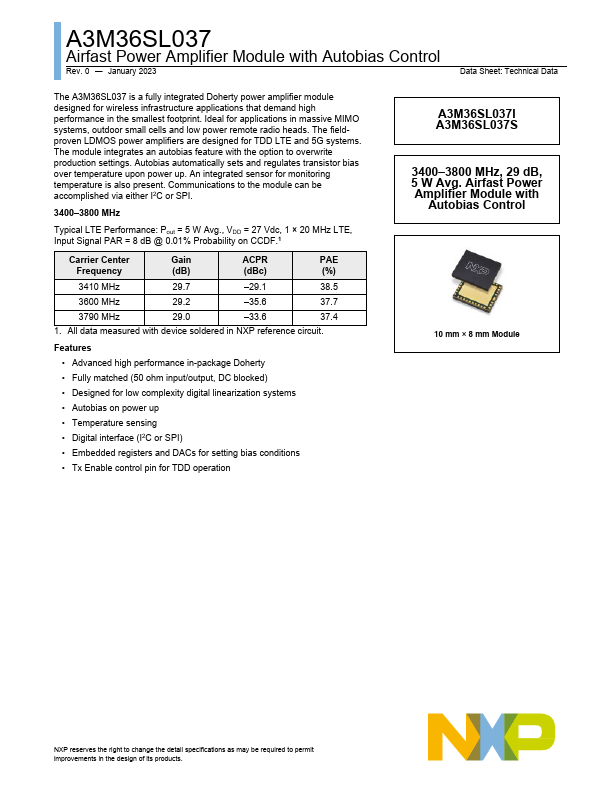
10 mm × 8 mm Module
NXP reserves the right to change the detail specifications as may be required to permit improvements in the design of its products.
Contents
1 1.1 1.2 2 2.1 2.1.1 2.1.2 2.1.3 2.1.4 2.2 2.2.1 2.2.2 2.2.3 2.2.4 3 3.1 3.2 4 5 5.1 5.2 5.3 5.4 5.5 5.6 6
Pinout configuration and function 3 Pin connections 3 Functional pin description
Electrical characteristics 4 Ratings 4 Maximum ratings 4 Lifetime 5 ESD protection characteristics 5 Moisture sensitivity level 5 Operating characteristics 5 Nominal DAC...