BUK200-50X
BUK200-50X is Power MOSFET manufactured by NXP Semiconductors.
DESCRIPTION
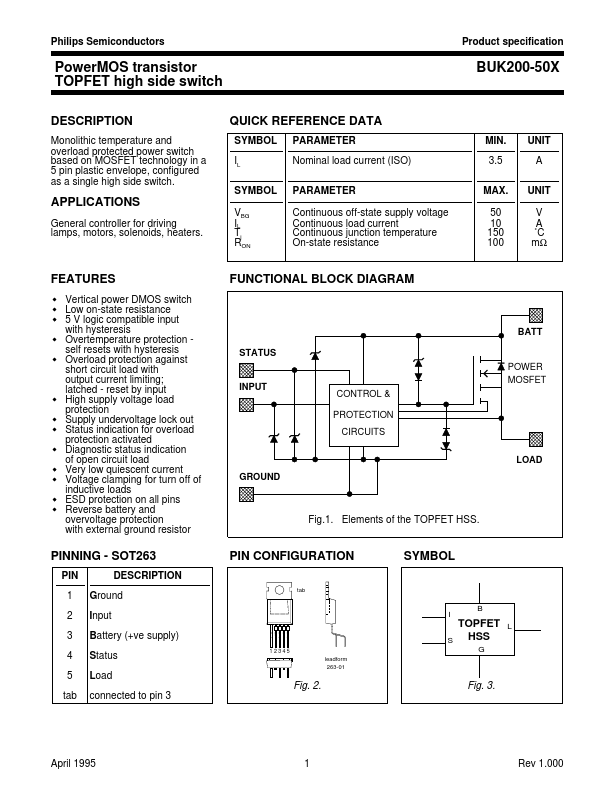
Monolithic temperature and overload protected power switch based on MOSFET technology in a 5 pin plastic envelope, configured as a single high side switch.
QUICK REFERENCE DATA
SYMBOL IL SYMBOL PARAMETER Nominal load current (ISO) PARAMETER Continuous off-state supply voltage Continuous load current Continuous junction temperature On-state resistance MIN. 3.5 MAX. 50 10 150 100 UNIT A UNIT V A ˚C mΩ
APPLICATIONS
General controller for driving lamps, motors, solenoids, heaters. VBG IL Tj RON
FEATURES
Vertical power DMOS switch Low on-state resistance 5 V logic patible input with hysteresis Overtemperature protection self resets with hysteresis Overload protection against short circuit load with output current limiting; latched
- reset by input High supply voltage load protection Supply undervoltage lock out Status indication for overload protection activated Diagnostic status indication of open circuit load Very low quiescent current Voltage clamping for turn off of inductive loads ESD protection on all pins Reverse battery and overvoltage protection with external ground resistor
FUNCTIONAL BLOCK DIAGRAM
BATT STATUS POWER MOSFET CONTROL & PROTECTION CIRCUITS LOAD GROUND
INPUT
Fig.1. Elements of the TOPFET HSS.
PINNING
- SOT263
PIN 1 2 3 4 5 tab DESCRIPTION
Ground Input Battery (+ve supply) Status Load
PIN CONFIGURATION tab
SYMBOL
1 2345
TOPFET HSS
L leadform 263-01
Fig. 2. connected to pin 3
Fig. 3.
April 1995
Rev 1.000
Philips Semiconductors
Product specification
Power MOS transistor TOPFET high side switch
LIMITING VALUES
Limiting values in accordance with the Absolute Maximum System (IEC 134) SYMBOL VBG PARAMETER Battery voltages Continuous off-state supply voltage Reverse battery voltages1 Repetitive peak supply voltage Continuous reverse supply voltage Continuous load current Total power dissipation Storage temperature Continuous junction temperature2 Lead temperature Input and status II IS II IS...