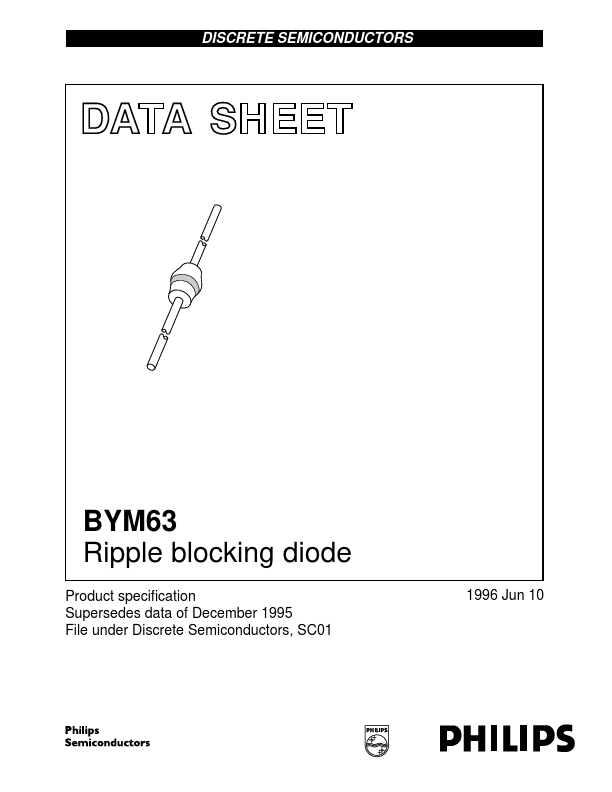
BYM63
BYM63 is Ripple blocking diode manufactured by NXP Semiconductors.
FEATURES
- Glass passivated
- High maximum operating temperature
- Low leakage current
- Excellent stability
- Guaranteed minimum turn-on time for absorbing forward current transients and oscillations
- Specially designed as rectifier in the auxiliary power supply in e.g. switched mode power supplies
- Available in ammo-pack.
- Also available with preformed leads for easy insertion. Fig.1 Simplified outline (SOD64) and symbol. DESCRIPTION
Rugged glass SOD64 package, using a high temperature alloyed construction.
This package is hermetically sealed and fatigue free as coefficients of expansion of all used parts are matched.
2/3 page k (Datasheet) a
MAM104
LIMITING VALUES In accordance with the Absolute Maximum Rating System (IEC 134). SYMBOL VRRM VR IF(AV) PARAMETER repetitive peak reverse voltage continuous reverse voltage average forward current averaged over any 20 ms period; Ttp = 55 °C; lead length = 10 mm; see Fig.2; see also Fig.4 averaged over any 20 ms period; Tamb = 65 °C; PCB mounting (Fig.8); see Fig.3; see also Fig.4 IFRM IFSM repetitive peak forward current non-repetitive peak forward current Ttp = 55 °C Tamb = 65 °C t = 10 ms half sine wave; Tj = Tj max prior to surge; VR = VRRMmax CONDITIONS MIN.
- -
- MAX. 300 300 2.4 V V A UNIT
- 1.0
- -
- 21 8.5 45
Tstg Tj storage temperature junction temperature
- 65
- 65
+175 +175
°C °C
1996 Jun 10
Philips Semiconductors
Product specification
Ripple blocking diode
ELECTRICAL CHARACTERISTICS Tj = 25 °C unless otherwise specified. SYMBOL VF IR PARAMETER forward voltage reverse current CONDITIONS IF = 2 A; Tj = Tj max; see Fig.5 IF = 2 A; see Fig.5 VR = VRRMmax; see Fig.6 VR = VRRMmax; Tj = 165 °C; see Fig.6 tfr ton forward recovery time turn-on time when switched to IF = 5 A in 50 ns; see Fig.9 when switched from VF = 0 V to VF = 3 V; measured between 10% and 90% of IF max; see Fig.11 when switched from IF = 0.5 A to IR = 1 A; measured at IR = 0.25 A; see Fig.11 f = 1 MHz; VR = 0...