

Datasheet4U Logo Datasheet4U.com

PF8201 - 9-channel power management

Download the PF8201 datasheet PDF. This datasheet also covers the PF8101 variant, as both devices belong to the same 9-channel power management family and are provided as variant models within a single manufacturer datasheet.

General Description

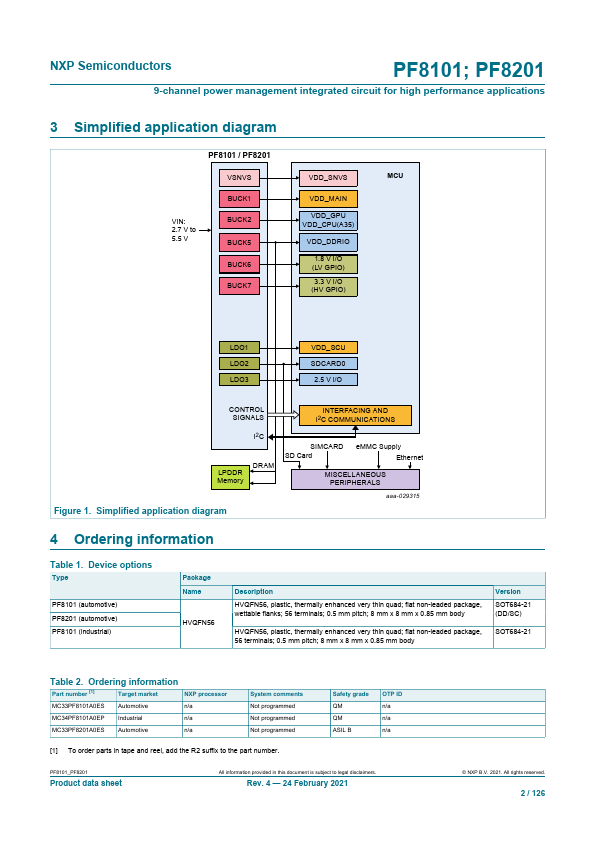
HVQFN56, plastic, thermally enhanced very thin quad; flat non-leaded package, wettable flanks; 56 terminals; 0.5 mm pitch; 8 mm x 8 mm x 0.85 mm body Version SOT684-21 (DD/SC) HVQFN56, plastic, thermally enhanced very thin quad; flat non-leaded package, SOT684-21 56 terminals; 0.5 mm pitch; 8 mm x

Key Features

  • five high efficiency buck converters and three linear regulators for powering the processor, memory and miscellaneous peripherals. Built-in one time programmable memory stores key startup configurations, drastically reducing external components typically used to set output voltage and sequence of external regulators. Regulator parameters are adjustable through high-speed I2C after start up offering flexibility for different system states. 2 Features.
  • Up to five high efficiency buck conv.

📥 Download Datasheet

Note: The manufacturer provides a single datasheet file (PF8101-NXP.pdf) that lists specifications for multiple related part numbers.

Full PDF Text Transcription (Reference)

The following content is an automatically extracted verbatim text from the original manufacturer datasheet and is provided for reference purposes only.

View original datasheet text
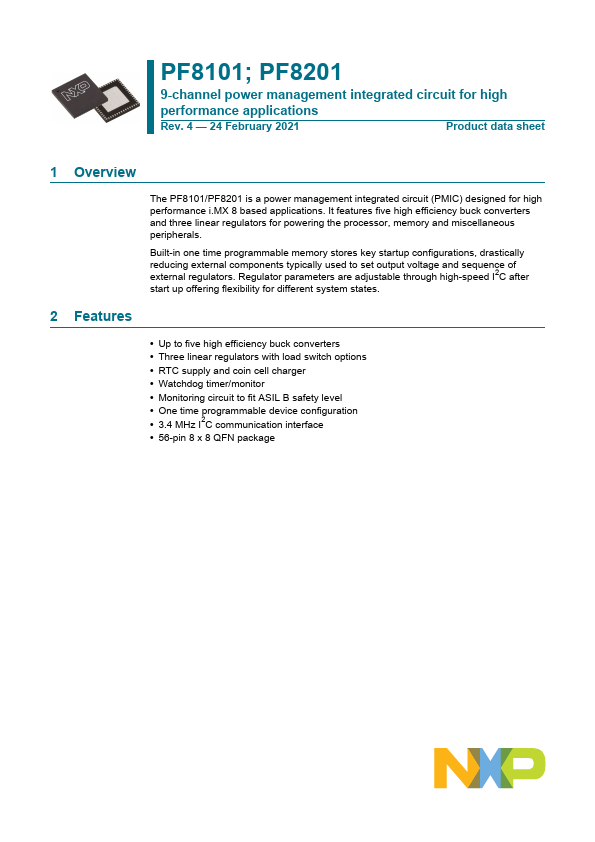
PF8101; PF8201 9-channel power management integrated circuit for high performance applications Rev. 4 — 24 February 2021 Product data sheet 1 Overview The PF8101/PF8201 is a power management integrated circuit (PMIC) designed for high performance i.MX 8 based applications. It features five high efficiency buck converters and three linear regulators for powering the processor, memory and miscellaneous peripherals. Built-in one time programmable memory stores key startup configurations, drastically reducing external components typically used to set output voltage and sequence of external regulators. Regulator parameters are adjustable through high-speed I2C after start up offering flexibility for different system states.