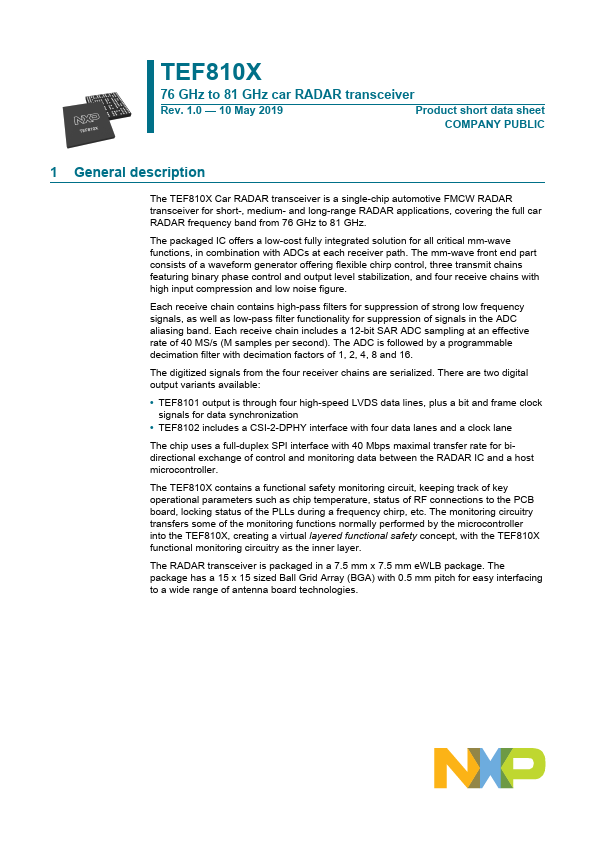
TEF8101
TEF8101 is car RADAR transceiver manufactured by NXP Semiconductors.
TEF810X
76 GHz to 81 GHz car RADAR transceiver
Rev. 1.0
- 10 May 2019
Product short data sheet
PANY PUBLIC
1 General description
The TEF810X Car RADAR transceiver is a single-chip automotive FMCW RADAR transceiver for short-, medium- and long-range RADAR applications, covering the full car RADAR frequency band from 76 GHz to 81 GHz.
The packaged IC offers a low-cost fully integrated solution for all critical mm-wave functions, in bination with ADCs at each receiver path. The mm-wave front end part consists of a waveform generator offering flexible chirp control, three transmit chains featuring binary phase control and output level stabilization, and four receive chains with high input pression and low noise figure.
Each receive chain contains high-pass filters for suppression of strong low frequency signals, as well as low-pass filter functionality for suppression of signals in the ADC aliasing band. Each receive chain includes a 12-bit SAR ADC sampling at an effective rate of 40 MS/s (M samples per second). The ADC is followed by a programmable decimation filter with decimation factors of 1, 2, 4, 8 and 16.
The digitized signals from the four receiver chains are serialized. There are two digital output variants available:
- TEF8101 output is through four high-speed LVDS data lines, plus a bit and frame clock signals for data synchronization
- TEF8102 includes a CSI-2-DPHY interface with four data lanes and a clock lane
The chip uses a full-duplex SPI interface with 40 Mbps maximal transfer rate for bidirectional exchange of control and monitoring data between the RADAR IC and a host microcontroller.
The TEF810X contains a functional safety monitoring circuit, keeping track of key operational parameters such as chip temperature, status of RF connections to the PCB board, locking status of the PLLs during a frequency chirp, etc. The monitoring circuitry transfers some of the monitoring functions normally performed by the microcontroller into the...