NXP Semiconductors TJA1053
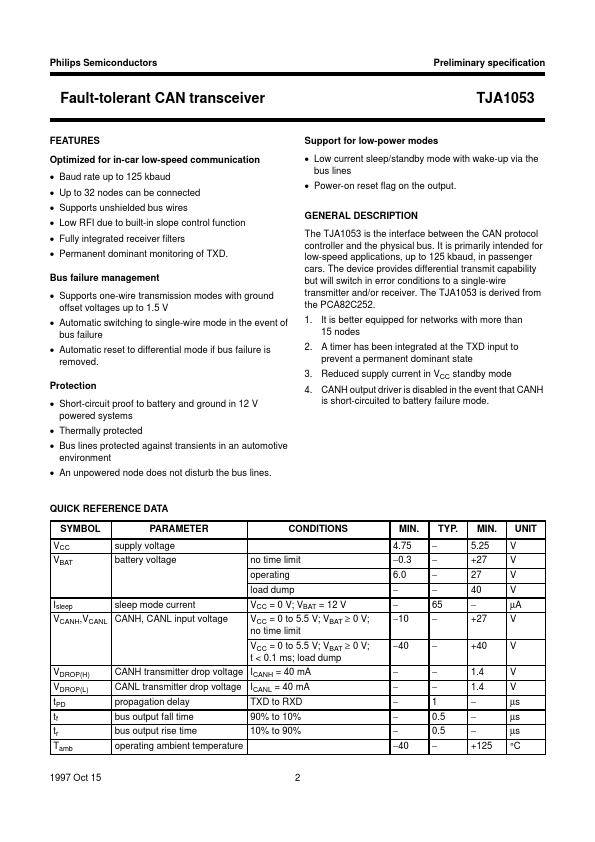
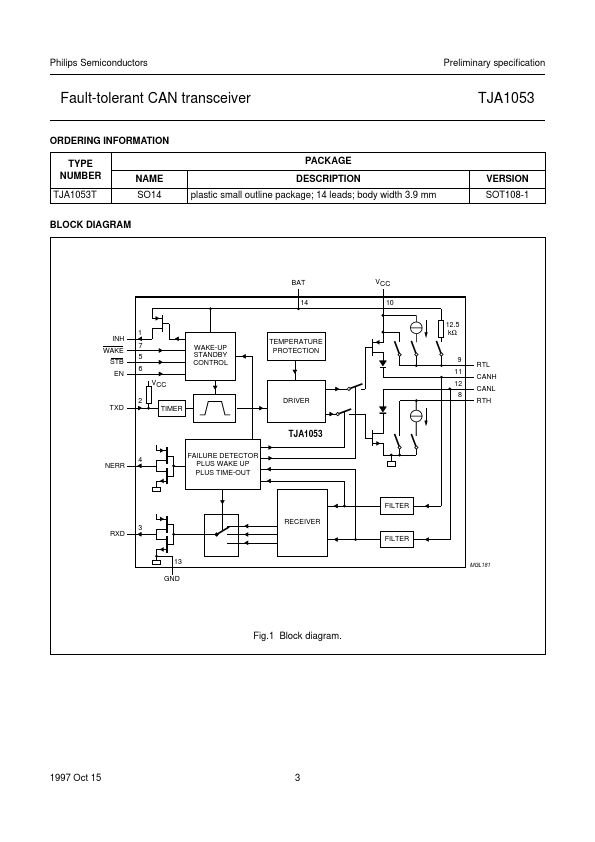
The TJA1053 is the interface between the CAN protocol controller and the physical bus. It is primarily intended for low-speed applications, up to 125 kbaud, in passenger cars. The device provides differential transmit capability but will switch in error conditions to a single-wire transmitter and/or receiver.| Part No. | TJA1053 |
|---|---|
| Datasheet | TJA1053 Download |
| Manufacturer |  NXP Semiconductors |
| Description | Fault-tolerant CAN transceiver |
| Buy | Stock & Price |

FEATURES
Optimized for in-car low-speed communication● Baud rate up to 125 kbaud
● Up to 32 nodes can be connected
● Supports unshielded bus wires
● Low RFI due to built-in slope control function
● Fully integrated receiver filters
● Permanent dominant monitoring of TXD. Bus failure management
● Supports one-wire transmission modes with ground offset voltages up to 1.5 V
● Automatic switching to single-wire mode in the event of bus failure
● Automatic reset to differential mode if bus failure is removed. Protection
● Short-circuit proof to battery and ground in 12 V powered systems
● Thermally protected
● Bus lines protected against transients in an automotive environment
● An unpowered node does not disturb the bus lines. Support for low-power modes TJA1053
● Low current sleep/standby mode with wake-up via the bus lines
● Power-on reset flag on the output.
GENERAL DESCRIPTION
The TJA1053 is derived from the PCA82C252. 1. It is better equipped for networks with more than 15 nodes 2. A timer has been integrated at the TXD input to prevent a permanent dominant state 3.