54AC574
54AC574 is Octal D-Type Flip-Flop manufactured by National Semiconductor.
..
- 54ACT574 Octal D-Type Flip-Flop with TRI-STATE Outputs
September 1998
- 54ACT574 Octal D-Type Flip-Flop with TRI-STATE ® Outputs
General Description
The ’AC/’ACT574 is a high-speed, low power octal flip-flop with a buffered mon Clock (CP) and a buffered mon Output Enable (OE). The information presented to the D inputs is stored in the flip-flops on the LOW-to-HIGH Clock (CP) transition. The ’AC/’ACT574 is functionally identical to the ’AC/’ACT374 except for the pinouts.
Features n ICC and IOZ reduced by 50% n Inputs and outputs on opposite sides of package allowing easy interface with microprocessors n Useful as input or output port for microprocessors n Functionally identical to ’AC/’ACT374 n TRI-STATE outputs for bus-oriented applications n Outputs source/sink 24 m A n ’ACT574 has TTL-patible inputs n Standard Microcircuit Drawing (SMD)
- ’ACT574: 5962-89601
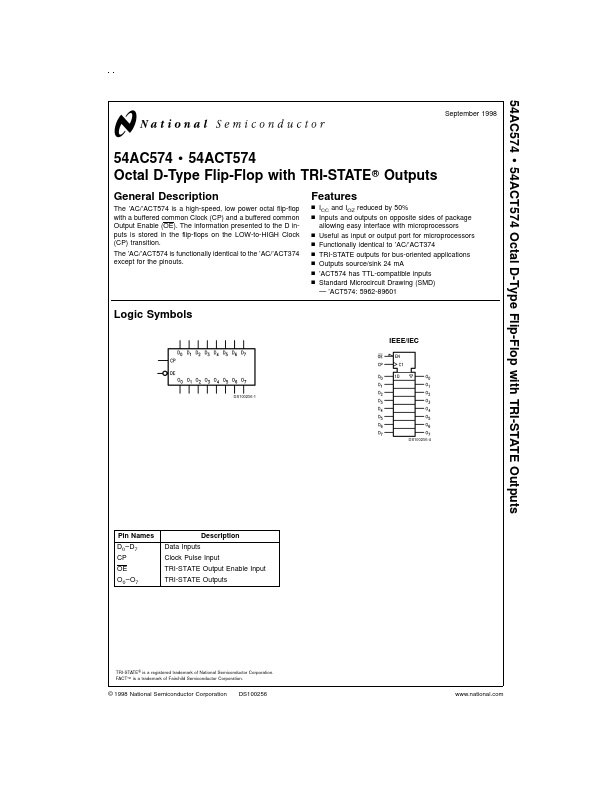
Logic Symbols
IEEE/IEC
DS100256-1
DS100256-4
Pin Names D0- D7 CP OE O0- O7 Data Inputs
Description Clock Pulse Input TRI-STATE Output Enable Input TRI-STATE Outputs
TRI-STATE ® is a registered trademark of National Semiconductor Corporation. FACT™ is a trademark of Fairchild Semiconductor Corporation.
© 1998 National Semiconductor Corporation
DS100256
.national.
Connection Diagrams
Pin Assignment for DIP, and Flatpak Pin Assignment for LCC
DS100256-2
DS100256-3
Functional Description
The ’AC/’ACT574 consists of eight edge-triggered flip-flops with individual D-type inputs and TRI-STATE true outputs. The buffered clock and buffered Output Enable are mon to all flip-flops. The eight flip-flops will store the state of their individual D inputs that meet the setup and hold time requirements on the LOW-to-HIGH Clock (CP) transition. With the Output Enable (OE) LOW, the contents of the eight flip-flops are available at the outputs. When OE is HIGH, the outputs go to the high impedance state. Operation of the OE input does not affect the state of...