Description
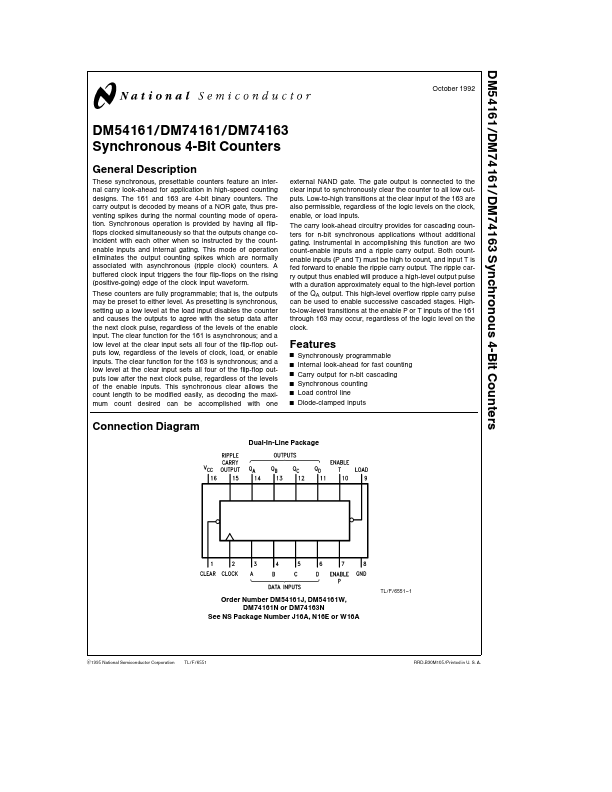
These synchronous presettable counters feature an internal carry look-ahead for application in high-speed counting designs The 161 and 163 are 4-bit binary counters The carry output is decoded by means of a NOR gate thus preventing spikes during the normal counting mode of operation Synchronous operation is provided by having all flipflops clocked simultaneously so that the outputs change coincident with each other when so instructed by the countenable inputs and internal gating This mode of operation eliminates the output counting spikes which are normally associated with asynchronous (ripple clock) counters A buffered clock input triggers the four flip-flops on the rising (positive-going) edge of the clock input waveform These counters are fully programmable that is the outputs may be preset to either level As presetting is synchronous setting up a low level at the load input disables the counter and causes the outputs to agree with the setup data after the next clock pulse regardless of the levels of the enable input The clear function for the 161 is asynchronous and a low level at the clear input sets all four of the flip-flop outputs low regardless of the levels of clock load or enable inputs The clear function for the 163 is synchronous and a low level at the clear input sets all four of the flip-flop outputs low after the next clock pulse regardless of the levels of the enable inputs This synchronous clear allows the count length to be modified easily as decoding the maximum count desired can be acplished with one external NAND gate The gate output is connected to the clear input to synchronously clear the counter to all low outputs Low-to-high transitions at the clear input of the 163 are also permissible regardless of the logic levels on the clock enable or load inputs The carry look-ahead circuitry provides for cascading counters for n-bit synchronous applications without additional gating Instrumental in acplishing this function are two count-enable inputs and a ripple carry output Both countenable inputs (P and T) must be high to count and input T is fed forward to enable the ripple carry output The ripple carry output thus enabled will produce a high-level output pulse with a duration approximately equal to the high-level portion of the QA output This high-level overflow ripple carry pulse can be used to enable successive cascaded stages Highto-low-level transitions at the enable P or T inputs of the 161 through 163 may occur regardless of the logic level on the clock.