Datasheet4U Logo Datasheet4U.com

DM54LS245 - TRI-STATE Octal Bus Transceiver

Description

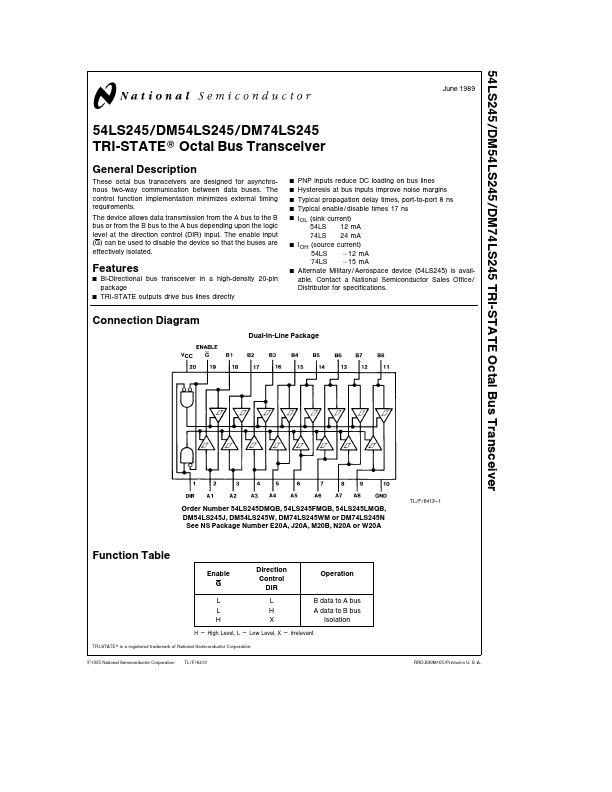
These octal bus transceivers are designed for asynchronous two-way communication between data buses The control function implementation minimizes external timing requirements The device allows data transmission from the A bus to the B bus or from the B bus to the A bus depending upon the logic level

Features

  • Y Y Y Bi-Directional bus transceiver in a high-density 20-pin package TRI-STATE outputs drive bus lines directly PNP inputs reduce DC loading on bus lines Hysteresis at bus inputs improve noise margins Typical propagation delay times port-to-port 8 ns Typical enable disable times 17 ns IOL (sink current) 54LS 12 mA 74LS 24 mA IOH (source current) b 12 mA 54LS b 15 mA 74LS Alternate Military Aerospace device (54LS245) is available Contact a National Semiconductor Sales Office Distributor for s.

📥 Download Datasheet

Datasheet preview – DM54LS245

Datasheet Details

Part number DM54LS245
Manufacturer National Semiconductor
File Size 139.96 KB
Description TRI-STATE Octal Bus Transceiver
Datasheet download datasheet DM54LS245 Datasheet
Additional preview pages of the DM54LS245 datasheet.
Other Datasheets by National Semiconductor

Full PDF Text Transcription

Click to expand full text
54LS245 DM54LS245 DM74LS245 TRI-STATE Octal Bus Transceiver June 1989 54LS245 DM54LS245 DM74LS245 TRI-STATE Octal Bus Transceiver General Description These octal bus transceivers are designed for asynchronous two-way communication between data buses The control function implementation minimizes external timing requirements The device allows data transmission from the A bus to the B bus or from the B bus to the A bus depending upon the logic level at the direction control (DIR) input The enable input (G) can be used to disable the device so that the buses are effectively isolated Y Y Y Y Y Y Features Y Y Y Bi-Directional bus transceiver in a high-density 20-pin package TRI-STATE outputs drive bus lines directly PNP inputs reduce DC loading on bus lines Hysteresis at bus inputs improv
Published: |