Datasheet4U Logo Datasheet4U.com

DM54LS257B - TRI-STATE Quad 2-Data Selectors/Multiplexers

Download the DM54LS257B datasheet PDF. This datasheet also covers the DM54LS257BJ variant, as both devices belong to the same tri-state quad 2-data selectors/multiplexers family and are provided as variant models within a single manufacturer datasheet.

General Description

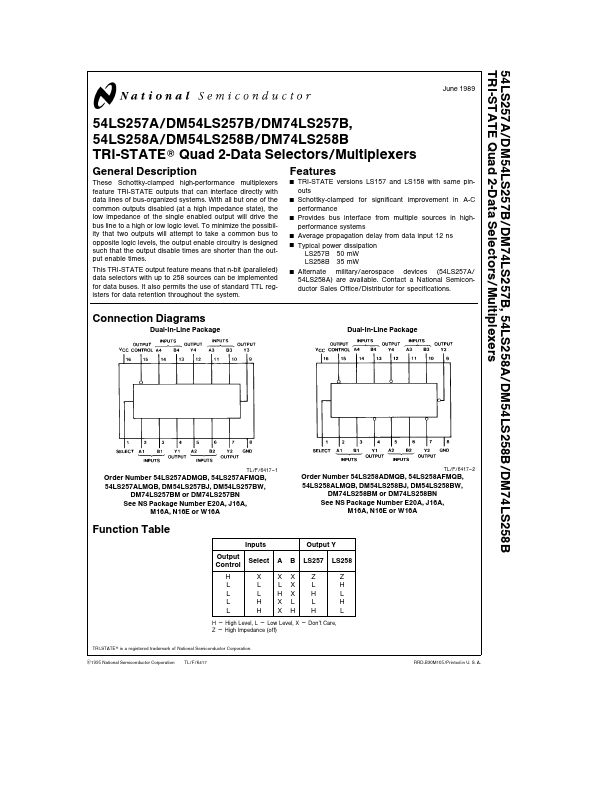
These Schottky-clamped high-performance multiplexers feature TRI-STATE outputs that can interface directly with data lines of bus-organized systems With all but one of the common outputs disabled (at a high impedance state) the low impedance of the single enabled output will drive the bus line to a

Key Features

  • Y TRI-STATE versions LS157 and LS158 with same pinouts Y Schottky-clamped for significant improvement in A-C performance Y Provides bus interface from multiple sources in highperformance systems Y Average propagation delay from data input 12 ns Y Typical power dissipation LS257B 50 mW LS258B 35 mW Y Alternate military aerospace devices (54LS257A 54LS258A) are available Contact a National Semiconductor Sales Office Distributor for specifications Connection Diagrams Dual-In-Line Package Dual-In-.

📥 Download Datasheet

Note: The manufacturer provides a single datasheet file (DM54LS257BJ_NationalSemiconductor.pdf) that lists specifications for multiple related part numbers.

Full PDF Text Transcription for DM54LS257B (Reference)

Note: Below is a high-fidelity text extraction (approx. 800 characters) for DM54LS257B. For precise diagrams, and layout, please refer to the original PDF.

54LS257A DM54LS257B DM74LS257B 54LS258A DM54LS258B DM74LS258B TRI-STATE Quad 2-Data Selectors Multiplexers June 1989 54LS257A DM54LS257B DM74LS257B 54LS258A DM54LS258B DM...

View more extracted text
lexers June 1989 54LS257A DM54LS257B DM74LS257B 54LS258A DM54LS258B DM74LS258B TRI-STATE Quad 2-Data Selectors Multiplexers General Description These Schottky-clamped high-performance multiplexers feature TRI-STATE outputs that can interface directly with data lines of bus-organized systems With all but one of the common outputs disabled (at a high impedance state) the low impedance of the single enabled output will drive the bus line to a high or low logic level To minimize the possibility that two outputs will attempt to take a common bus to opposite logic levels the output enable circuitry is designed such that the outp