LM2623
LM2623 is DC/DC Boost Converter manufactured by National Semiconductor.
- Part of the LM2 comparator family.
- Part of the LM2 comparator family.
Description
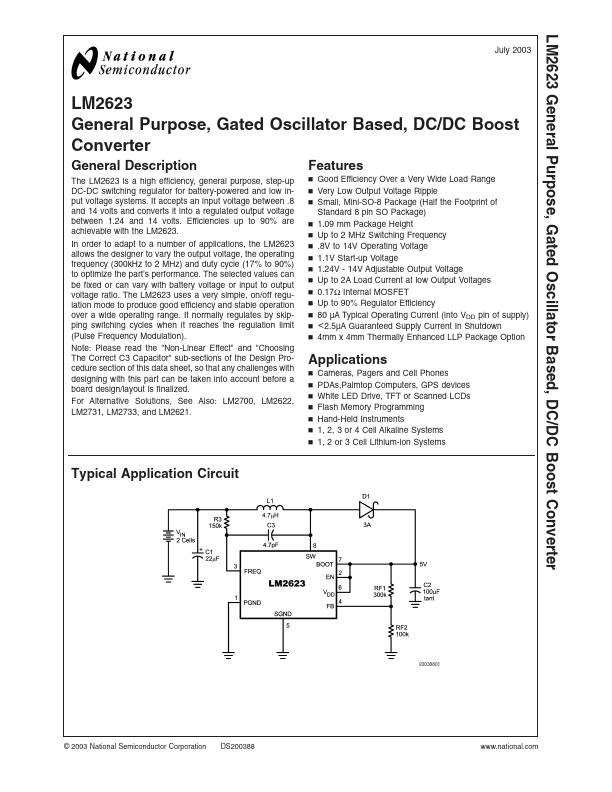
The LM2623 is a high efficiency, general purpose, step-up DC-DC switching regulator for battery-powered and low input voltage systems. It accepts an input voltage between .8 and 14 volts and converts it into a regulated output voltage between 1.24 and 14 volts. Efficiencies up to 90% are achievable with the LM2623. In order to adapt to a number of applications, the LM2623 allows the designer to vary the output voltage, the operating frequency (300k Hz to 2 MHz) and duty cycle (17% to 90%) to optimize the part’s performance. The selected values can be fixed or can vary with battery voltage or input to output voltage ratio. The LM2623 uses a very simple, on/off regulation mode to produce good efficiency and stable operation over a wide operating range. It normally regulates by skipping switching cycles when it reaches the regulation limit (Pulse Frequency Modulation). Note: Please read the "Non-Linear Effect" and "Choosing The Correct C3 Capacitor" sub-sections of the Design Procedure section of this data sheet, so that any challenges with designing with this part can be taken into account before a board design/layout is finalized. For Alternative Solutions, See Also: LM2700, LM2622, LM2731, LM2733, and LM2621.
Features n Good Efficiency Over a Very Wide Load Range n Very Low Output Voltage Ripple n Small, Mini-SO-8 Package (Half the Footprint of Standard 8 pin SO Package) n 1.09 mm Package Height n Up to 2 MHz Switching Frequency n .8V to 14V Operating Voltage n 1.1V Start-up Voltage n 1.24V
- 14V Adjustable Output Voltage n Up to 2A Load Current at low Output Voltages n 0.17Ω Internal MOSFET n Up to 90% Regulator Efficiency n 80 µA Typical Operating Current (into VDD pin of supply) n < 2.5µA Guaranteed Supply Current In Shutdown n 4mm x 4mm Thermally Enhanced LLP Package Option
Applications n n n n n n n Cameras, Pagers and Cell Phones PDAs,Palmtop puters, GPS devices White LED Drive, TFT or Scanned LCDs Flash Memory Programming Hand-Held Instruments...