Datasheet4U Logo Datasheet4U.com

LM2698 - SIMPLE SWITCHER 1.35A Boost Regulator

Datasheet Summary

Description

The LM2698 is a general purpose PWM boost converter.

The 1.9A, 18V, 0.2ohm internal switch enables the LM2698 to provide efficient power conversion to outputs ranging from 2.2V to 17V.

It can operate with input voltages as low as 2.2V and as high as 12V.

Features

  • a pin selectable switching frequency of either 600kHz or 1.25MHz. This promotes flexibility in component selection and filtering techniques. A shutdown pin is available to suspend the device and decrease the quiescent current to 5µA. An external compensation pin gives the user flexibility in setting frequency compensation, which makes possible the use of small, low ESR ceramic capacitors at the output. Switchers Made Simple ® software is available to insure a quick, easy and guaranteed design. T.

📥 Download Datasheet

Datasheet preview – LM2698

Datasheet Details

Part number LM2698
Manufacturer National Semiconductor
File Size 503.72 KB
Description SIMPLE SWITCHER 1.35A Boost Regulator
Datasheet download datasheet LM2698 Datasheet
Additional preview pages of the LM2698 datasheet.
Other Datasheets by National Semiconductor

Full PDF Text Transcription

Click to expand full text
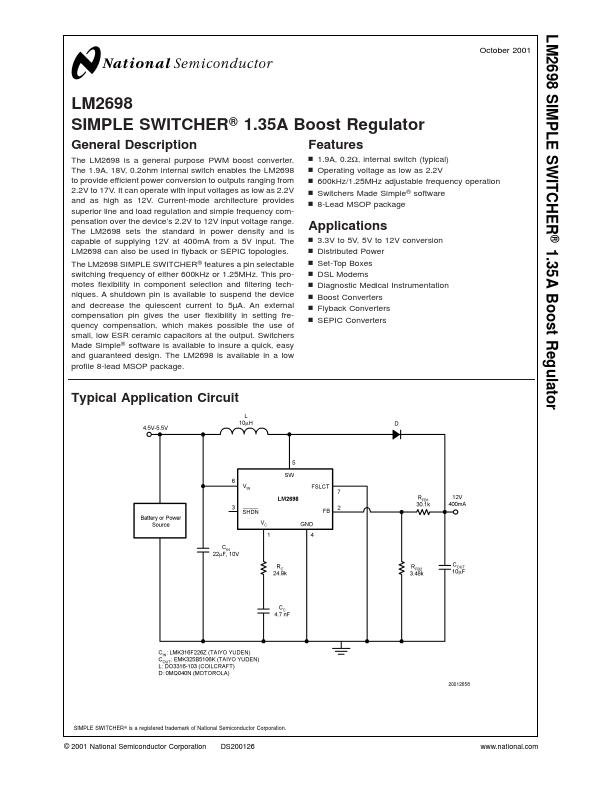
LM2698 SIMPLE SWITCHER ® 1.35A Boost Regulator October 2001 LM2698 SIMPLE SWITCHER ® 1.35A Boost Regulator General Description The LM2698 is a general purpose PWM boost converter. The 1.9A, 18V, 0.2ohm internal switch enables the LM2698 to provide efficient power conversion to outputs ranging from 2.2V to 17V. It can operate with input voltages as low as 2.2V and as high as 12V. Current-mode architecture provides superior line and load regulation and simple frequency compensation over the device’s 2.2V to 12V input voltage range. The LM2698 sets the standard in power density and is capable of supplying 12V at 400mA from a 5V input. The LM2698 can also be used in flyback or SEPIC topologies. The LM2698 SIMPLE SWITCHER ® features a pin selectable switching frequency of either 600kHz or 1.
Published: |