Datasheet4U Logo Datasheet4U.com

LM2745 - (LM2745 / LM2748) Synchronous Buck Controller

Download the LM2745 datasheet PDF. This datasheet also covers the LM2748 variant, as both devices belong to the same (lm2745 / lm2748) synchronous buck controller family and are provided as variant models within a single manufacturer datasheet.

General Description

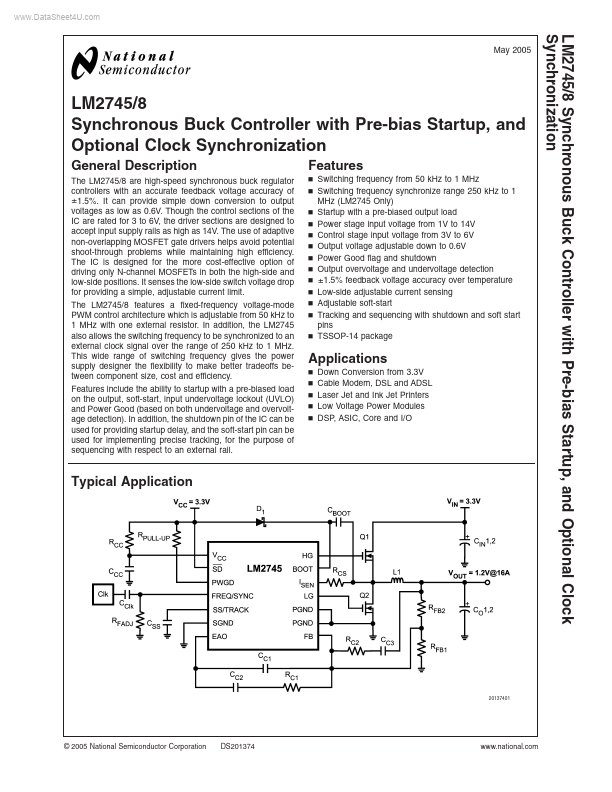
The LM2745/8 are high-speed synchronous buck regulator controllers with an accurate feedback voltage accuracy of ± 1.5%.

It can provide simple down conversion to output voltages as low as 0.6V.

Key Features

  • a fixed-frequency voltage-mode PWM control architecture which is adjustable from 50 kHz to 1 MHz with one external resistor. In addition, the LM2745 also allows the switching frequency to be synchronized to an external clock signal over the range of 250 kHz to 1 MHz. This wide range of switching frequency gives the power supply designer the flexibility to make better tradeoffs between component size, cost and efficiency. Features include the ability to startup with a pre-biased load on the outpu.

📥 Download Datasheet

Note: The manufacturer provides a single datasheet file (LM2748_NationalSemiconductor.pdf) that lists specifications for multiple related part numbers.

Full PDF Text Transcription (Reference)

The following content is an automatically extracted verbatim text from the original manufacturer datasheet and is provided for reference purposes only.

View original datasheet text
www.DataSheet4U.com LM2745/8 Synchronous Buck Controller with Pre-bias Startup, and Optional Clock Synchronization May 2005 LM2745/8 Synchronous Buck Controller with Pre-bias Startup, and Optional Clock Synchronization General Description The LM2745/8 are high-speed synchronous buck regulator controllers with an accurate feedback voltage accuracy of ± 1.5%. It can provide simple down conversion to output voltages as low as 0.6V. Though the control sections of the IC are rated for 3 to 6V, the driver sections are designed to accept input supply rails as high as 14V. The use of adaptive non-overlapping MOSFET gate drivers helps avoid potential shoot-through problems while maintaining high efficiency.