LM88
LM88 is Factory Programmable Dual Remote-Diode Thermostat manufactured by National Semiconductor.
Description
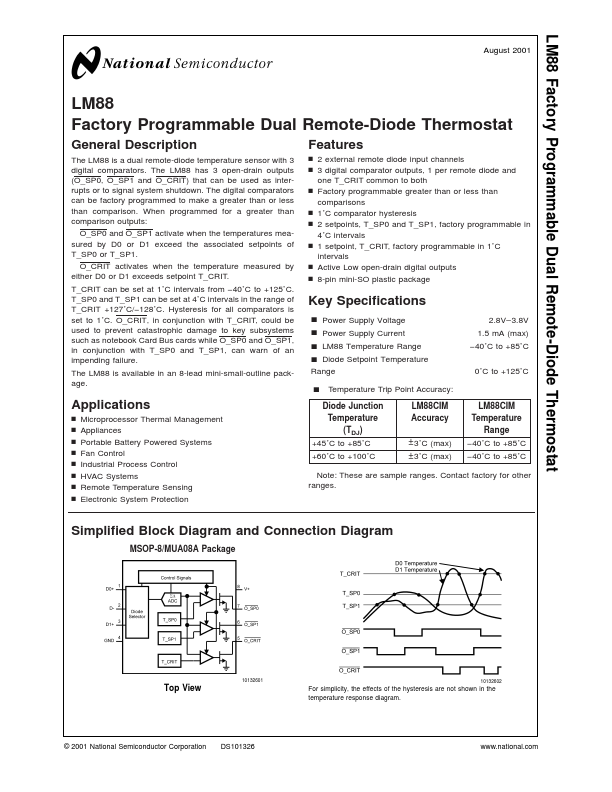
The LM88 is a dual remote-diode temperature sensor with 3 digital parators. The LM88 has 3 open-drain outputs (O_SP0, O_SP1 and O_CRIT) that can be used as interrupts or to signal system shutdown. The digital parators can be factory programmed to make a greater than or less than parison. When programmed for a greater than parison outputs: O_SP0 and O_SP1 activate when the temperatures measured by D0 or D1 exceed the associated setpoints of T_SP0 or T_SP1. O_CRIT activates when the temperature measured by either D0 or D1 exceeds setpoint T_CRIT. T_CRIT can be set at 1˚C intervals from
- 40˚C to +125˚C. T_SP0 and T_SP1 can be set at 4˚C intervals in the range of T_CRIT +127˚C/- 128˚C. Hysteresis for all parators is set to 1˚C. O_CRIT, in conjunction with T_CRIT, could be used to prevent catastrophic damage to key subsystems such as notebook Card Bus cards while O_SP0 and O_SP1, in conjunction with T_SP0 and T_SP1, can warn of an impending failure. The LM88 is available in an 8-lead mini-small-outline package.
Features n 2 external remote diode input channels n 3 digital parator outputs, 1 per remote diode and one T_CRIT mon to both n Factory programmable greater than or less than parisons n 1˚C parator hysteresis n 2 setpoints, T_SP0 and T_SP1, factory programmable in 4˚C intervals n 1 setpoint, T_CRIT, factory programmable in 1˚C intervals n Active Low open-drain digital outputs n 8-pin mini-SO plastic package
Key Specifications j Power Supply Voltage j Power Supply Current j LM88 Temperature Range j Diode Setpoint Temperature Range j
2.8V- 3.8V 1.5 m A (max)
- 40˚C to +85˚C 0˚C to +125˚C
Temperature Trip Point Accuracy: Diode Junction Temperature (TDJ) LM88CIM Accuracy LM88CIM Temperature Range
- 40˚C to +85˚C
- 40˚C to +85˚C
Applications n n n n n n n n Microprocessor Thermal Management Appliances Portable Battery Powered Systems Fan Control Industrial Process Control HVAC Systems Remote Temperature Sensing Electronic System Protection
+45˚C to +85˚C...