Datasheet4U Logo Datasheet4U.com

LM9044 - LM9044 Lambda Sensor Interface Amplifier

Datasheet Summary

Description

The LM9044 is a precision differential amplifier specifically designed for operation in the automotive environment Gain accuracy is guaranteed over the entire automotive temperature range (b40 C to a 125 C) and is factory trimmed prior to package assembly The input circuitry has been specifically de

Features

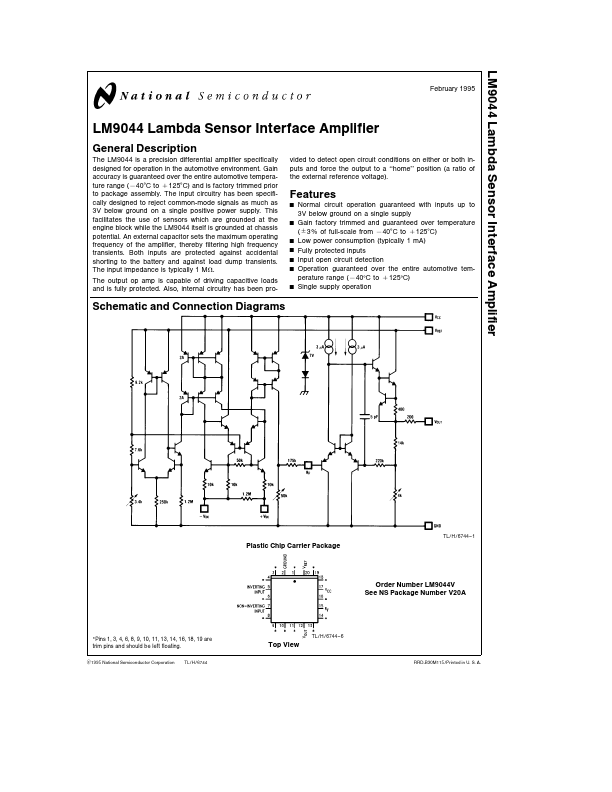
  • Y Y Y Y Y Y Y Normal circuit operation guaranteed with inputs up to 3V below ground on a single supply Gain factory trimmed and guaranteed over temperature ( g 3% of full-scale from b40 C to a 125 C) Low power consumption (typically 1 mA) Fully protected inputs Input open circuit detection Operation guaranteed over the entire automotive temperature range (b40 C to a 125 C) Single supply operation Schematic and Connection Diagrams TL H 6744.
  • 1 Plastic Chip Carrier Package Order Nu.

📥 Download Datasheet

Datasheet preview – LM9044

Datasheet Details

Part number LM9044
Manufacturer National Semiconductor
File Size 125.42 KB
Description LM9044 Lambda Sensor Interface Amplifier
Datasheet download datasheet LM9044 Datasheet
Additional preview pages of the LM9044 datasheet.
Other Datasheets by National Semiconductor

Full PDF Text Transcription

Click to expand full text
LM9044 Lambda Sensor Interface Amplifier February 1995 LM9044 Lambda Sensor Interface Amplifier General Description The LM9044 is a precision differential amplifier specifically designed for operation in the automotive environment Gain accuracy is guaranteed over the entire automotive temperature range (b40 C to a 125 C) and is factory trimmed prior to package assembly The input circuitry has been specifically designed to reject common-mode signals as much as 3V below ground on a single positive power supply This facilitates the use of sensors which are grounded at the engine block while the LM9044 itself is grounded at chassis potential An external capacitor sets the maximum operating frequency of the amplifier thereby filtering high frequency transients Both inputs are protected agains
Published: |