LMS1487
LMS1487 is 5V Low Power RS-485 / RS-422 Differential Bus Transceiver manufactured by National Semiconductor.
Description
The LMS1487 is a low power differential bus/line transceiver designed for high speed bidirectional data munication on multipoint bus transmission lines. It is designed for balanced transmission lines. It meets ANSI Standards TIA/EIA RS422B, TIA/EIA RS485-A and ITU remendation and V.11 and X.27. The LMS1487 bines a TRI-STATE® differential line driver and differential input receiver, both of which operate from a single 5.0V power supply. The driver and receiver have an active high and active low, respectively, that can be externally connected to function as a direction control. The driver and receiver differential inputs are internally connected to form differential input/output (I/O) bus ports that are designed to offer minimum loading to bus whenever the driver is disabled or when VCC = 0V. These ports feature wide positive and negative mon mode voltage ranges, making the device suitable for multipoint applications in noisy environments. The LMS1487 is available in a 8-Pin SOIC and 8-pin DIP packages. It is a drop-in socket replacement to Maxim’s MAX1487
Features
- Meet ANSI standard RS-485-A and RS-422-B
- Data rate 2.5 Mbps
- Single supply voltage operation, 5V
- Wide input and output voltage range
- Thermal shutdown protection
- Short circuit protection
- Low quiescent current 320μA
- Allows up to 128 transceivers on the bus
- Open circuit fail-safe for receiver
- Extended operating temperature range
- 40°C to 85°C
- Drop-in replacement to MAX1487
- Available in 8-pin SOIC and 8-pin DIP package
Applications
- Low power RS-485 systems
- Network hubs, bridges, and routers
- Point of sales equipment (ATM, barcode scanners,…)
- Local area networks (LAN)
- Integrated service digital network (ISDN)
- Industrial programmable logic controllers
- High speed parallel and serial applications
- Multipoint applications with noisy environment
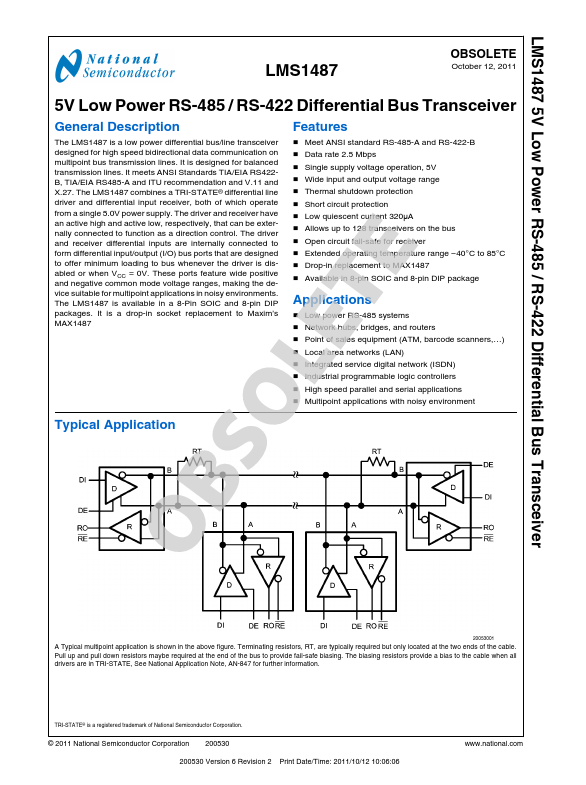
Typical Application
A Typical multipoint application is shown in the above figure. Terminating resistors, RT,...