Datasheet4U Logo Datasheet4U.com

MH0012C - high speed MOS clock driver

Download the MH0012C datasheet PDF. This datasheet also covers the MH0012 variant, as both devices belong to the same high speed mos clock driver family and are provided as variant models within a single manufacturer datasheet.

General Description

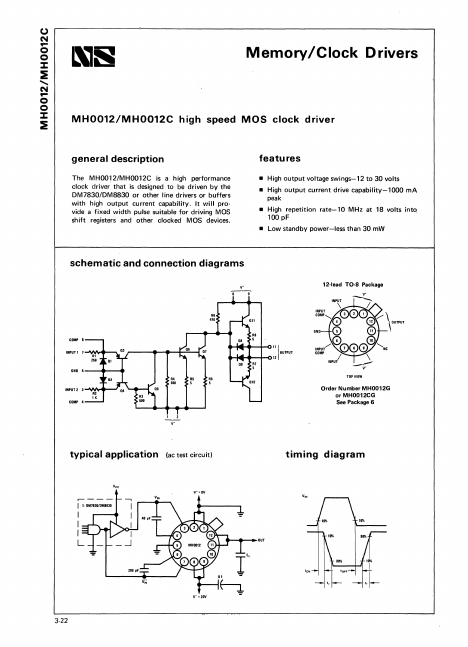
The MH0012/MH0012C is a high performance clock driver that is designed to be driven by the DM7830/DM8830 or other line drivers or buffers with high output current capability.

It will provide a fixed width pulse suitable for driving MOS shift registers and other clocked MOS devices.

Key Features

  • High output voltage swings-12 to 30 volts.
  • High output current drive capability-lOOO mA peak.
  • High repetition rate-lO MHz at 18 volts into 100 pF.
  • Low standby power-less than 30 mW schematic and connection diagrams y'.
  • 9 COMP 8 INPUT 1 1 AI 26. GNO 5 tNPUT2 3 COMP . . ""' '"" 11 10UT,UT -14-11-" ,2 y- 12-lead TO.
  • S Package TOP VIEW Order Number MH0012G or MH0012CG See Package 6 typical.

📥 Download Datasheet

Note: The manufacturer provides a single datasheet file (MH0012-NationalSemiconductor.pdf) that lists specifications for multiple related part numbers.

Full PDF Text Transcription (Reference)

The following content is an automatically extracted verbatim text from the original manufacturer datasheet and is provided for reference purposes only.

View original datasheet text
CJ oo~ Memory/Clock Drivers :t :E "N oo~ :t :E MH0012/MH0012C high speed MOS clock driver general description The MH0012/MH0012C is a high performance clock driver that is designed to be driven by the DM7830/DM8830 or other line drivers or buffers with high output current capability. It will provide a fixed width pulse suitable for driving MOS shift registers and other clocked MOS devices. features • High output voltage swings-12 to 30 volts • High output current drive capability-lOOO mA peak • High repetition rate-lO MHz at 18 volts into 100 pF • Low standby power-less than 30 mW schematic and connection diagrams y' •9 COMP 8 INPUT 1 1 AI 26. GNO 5 tNPUT2 3 COMP .. ""' '"" 11 10UT,UT ...-14.....