Datasheet4U Logo Datasheet4U.com

DM86LS62 - Dual Rank 8-Bit TRI-STATE Shift Register

General Description

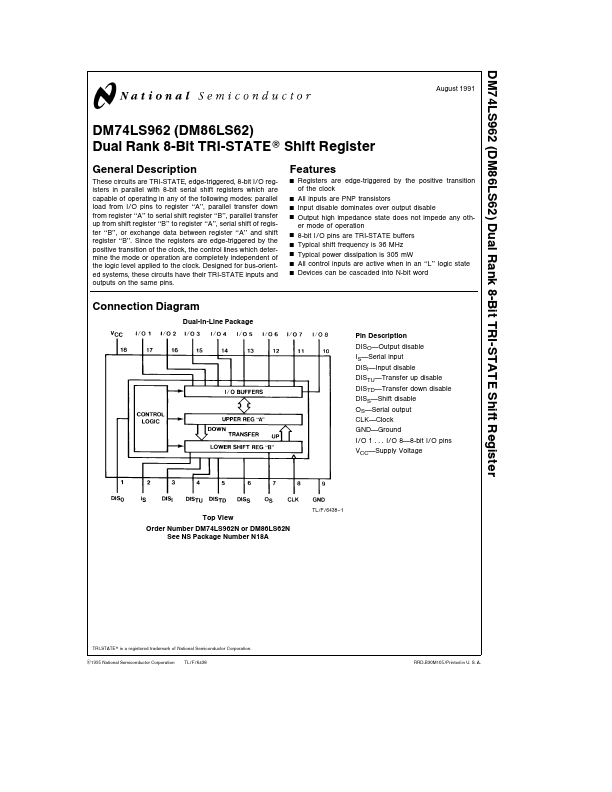
These circuits are TRI-STATE edge-triggered 8-bit I O registers in parallel with 8-bit serial shift registers which are capable of operating in any of the following modes parallel load from I O pins to register ‘‘A’’ parallel transfer down from register ‘‘A’’ to serial shift register ‘‘B’’ parallel

Key Features

  • Y Y Y Y Y Y Y Y Y Registers are edge-triggered by the positive transition of the clock All inputs are PNP transistors Input disable dominates over output disable Output high impedance state does not impede any other mode of operation 8-bit I O pins are TRI-STATE buffers Typical shift frequency is 36 MHz Typical power dissipation is 305 mW All control inputs are active when in an ‘‘L’’ logic state Devices can be cascaded into N-bit word Connection Diagram Dual-In-Line Package Pin.

📥 Download Datasheet

Datasheet Details

Part number DM86LS62
Manufacturer National
File Size 157.99 KB
Description Dual Rank 8-Bit TRI-STATE Shift Register
Datasheet download datasheet DM86LS62 Datasheet

Full PDF Text Transcription (Reference)

The following content is an automatically extracted verbatim text from the original manufacturer datasheet and is provided for reference purposes only.

View original datasheet text
DM74LS962 (DM86LS62) Dual Rank 8-Bit TRI-STATE Shift Register August 1991 DM74LS962 (DM86LS62) Dual Rank 8-Bit TRI-STATE Shift Register General Description These circuits are TRI-STATE edge-triggered 8-bit I O registers in parallel with 8-bit serial shift registers which are capable of operating in any of the following modes parallel load from I O pins to register ‘‘A’’ parallel transfer down from register ‘‘A’’ to serial shift register ‘‘B’’ parallel transfer up from shift register ‘‘B’’ to register ‘‘A’’ serial shift of register ‘‘B’’ or exchange data between register ‘‘A’’ and shift register ‘‘B’’ Since the registers are edge-triggered by the positive transition of the clock the control lines which determine the mode or operation are completely independent of the logic level applied t