Overview
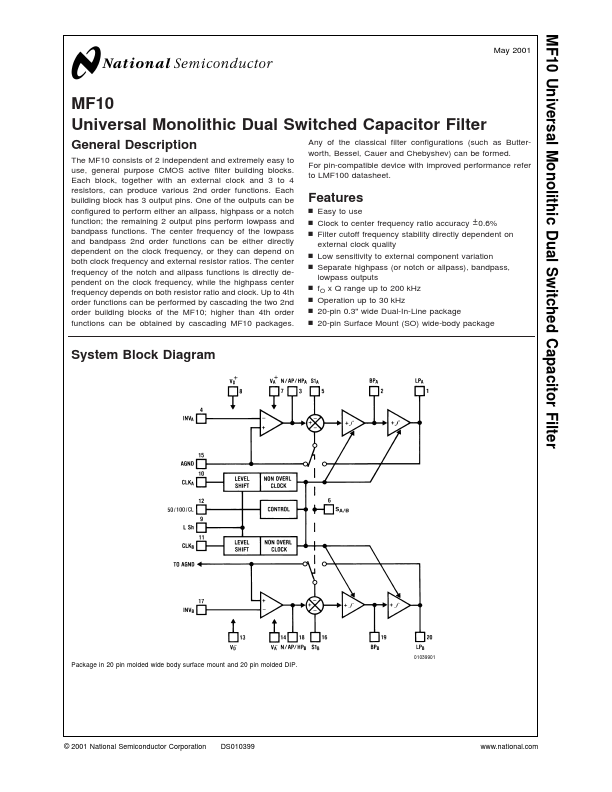
The MF10 consists of 2 independent and extremely easy to use general purpose CMOS active filter building blocks Each block together with an external clock and 3 to 4 resistors can produce various 2nd order functions Each building block has 3 output pins One of the outputs can be configured to perform either an allpass highpass or a notch function the remaining 2 output pins perform lowpass and bandpass functions The center frequency of the lowpass and bandpass 2nd order functions can be either directly dependent on the clock frequency or they can depend on both clock frequency and external resistor ratios The center frequency of the notch and allpass functions is directly dependent on the clock frequency while the highpass center frequency depends on both resistor ratio and clock Up to 4th order functions can be performed by cascading the two 2nd order building blocks of the MF10 higher than 4th order functions can be obtained by cascading MF10 packages Any of the classical filter configurations (such as Butterworth Bessel Cauer and Chebyshev) can be formed For pin-compatible device with improved performance refer to LMF100 datasheet.