Datasheet4U Logo Datasheet4U.com

MM54C85 - 4-Bit Magnitude Comparator

General Description

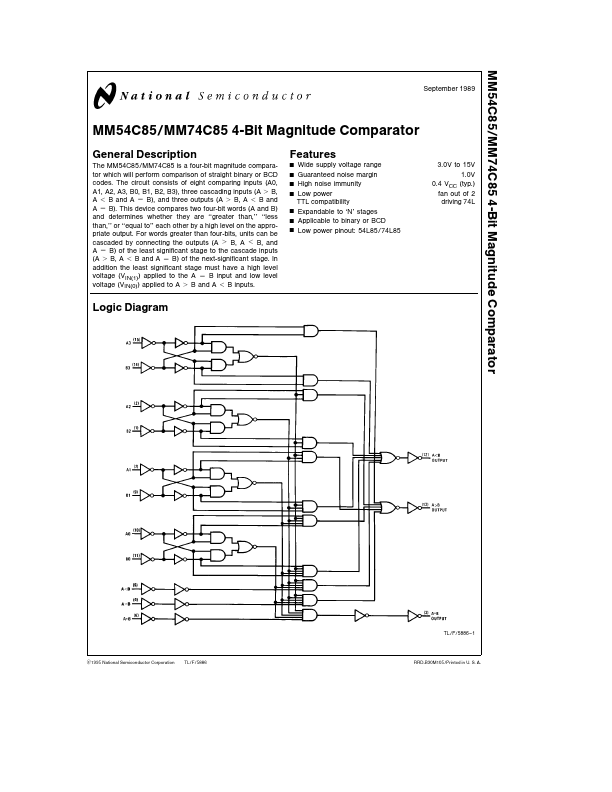
The MM54C85 MM74C85 is a four-bit magnitude comparator which will perform comparison of straight binary or BCD codes The circuit consists of eight comparing inputs (A0 A1 A2 A3 B0 B1 B2 B3) three cascading inputs (A l B A k B and A e B) and three outputs (A l B A k B and A e B) This device compares

Key Features

  • Y Y Y Y Y Y Y Wide supply voltage range Guaranteed noise margin High noise immunity Low power TTL compatibility Expandable to ‘N’ stages Applicable to binary or BCD Low power pinout 54L85 74L85 3 0V to 15V 1 0V 0 4 VCC (typ ) fan out of 2 driving 74L Logic Diagram TL F 5886.
  • 1 C1995 National Semiconductor Corporation TL F 5886 RRD-B30M105 Printed in U S A Absolute Maximum Ratings (Note 1) If Military Aerospace specified devices are required please contact the National Semicondu.

📥 Download Datasheet

Datasheet Details

Part number MM54C85
Manufacturer National
File Size 116.40 KB
Description 4-Bit Magnitude Comparator
Datasheet download datasheet MM54C85 Datasheet

Full PDF Text Transcription (Reference)

The following content is an automatically extracted verbatim text from the original manufacturer datasheet and is provided for reference purposes only.

View original datasheet text
MM54C85 MM74C85 4-Bit Magnitude Comparator September 1989 MM54C85 MM74C85 4-Bit Magnitude Comparator General Description The MM54C85 MM74C85 is a four-bit magnitude comparator which will perform comparison of straight binary or BCD codes The circuit consists of eight comparing inputs (A0 A1 A2 A3 B0 B1 B2 B3) three cascading inputs (A l B A k B and A e B) and three outputs (A l B A k B and A e B) This device compares two four-bit words (A and B) and determines whether they are ‘‘greater than ’’ ‘‘less than ’’ or ‘‘equal to’’ each other by a high level on the appropriate output For words greater than four-bits units can be cascaded by connecting the outputs (A l B A k B and A e B) of the least significant stage to the cascade inputs (A l B A k B and A e B) of the next-significant stage In