DS75154
DS75154 is Quad Line Receiver manufactured by National Semiconductor.
Description
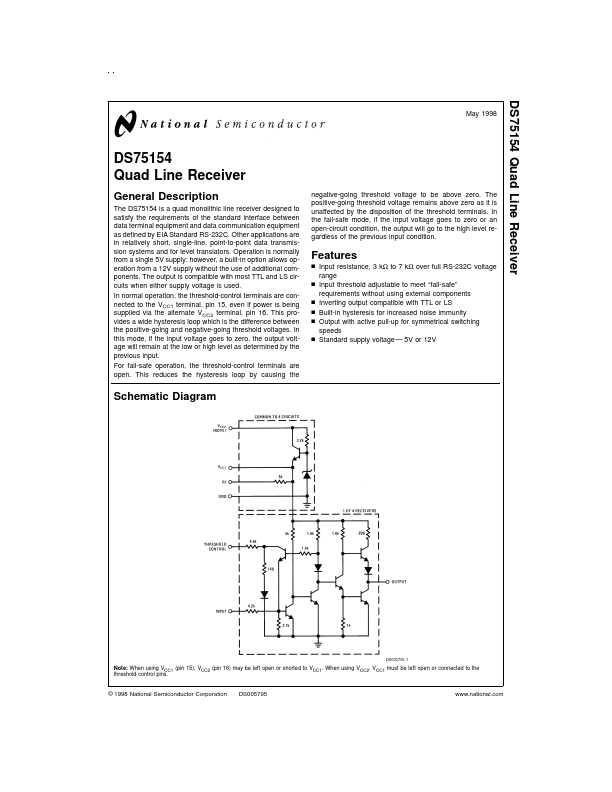
The DS75154 is a quad monolithic line receiver designed to satisfy the requirements of the standard interface between data terminal equipment and data munication equipment as defined by EIA Standard RS-232C. Other applications are in relatively short, single-line, point-to-point data transmission systems and for level translators. Operation is normally from a single 5V supply; however, a built-in option allows operation from a 12V supply without the use of additional ponents. The output is patible with most TTL and LS circuits when either supply voltage is used. In normal operation, the threshold-control terminals are connected to the VCC1 terminal, pin 15, even if power is being supplied via the alternate VCC2 terminal, pin 16. This provides a wide hysteresis loop which is the difference between the positive-going and negative-going threshold voltages. In this mode, if the input voltage goes to zero, the output voltage will remain at the low or high level as determined by the previous input. For fail-safe operation, the threshold-control terminals are open. This reduces the hysteresis loop by causing the negative-going threshold voltage to be above zero. The positive-going threshold voltage remains above zero as it is unaffected by the disposition of the threshold terminals. In the fail-safe mode, if the input voltage goes to zero or an open-circuit condition, the output will go to the high level regardless of the previous input condition.
Features n Input resistance, 3 kΩ to 7 kΩ over full RS-232C voltage range n Input threshold adjustable to meet “fail-safe” requirements without using external ponents n Inverting output patible with TTL or LS n Built-in hysteresis for increased noise immunity n Output with active pull-up for symmetrical switching speeds n Standard supply voltage
- 5V or 12V
Schematic Diagram
DS005795-1
Note: When using VCC1 (pin 15), VCC2 (pin 16) may be left open or shorted to VCC1. When using VCC2, VCC1 must be left open or...