LM2422
LM2422 is 220V Monolithic Triple Channel 30MHz CRT DTV Driver manufactured by National Semiconductor.
Description
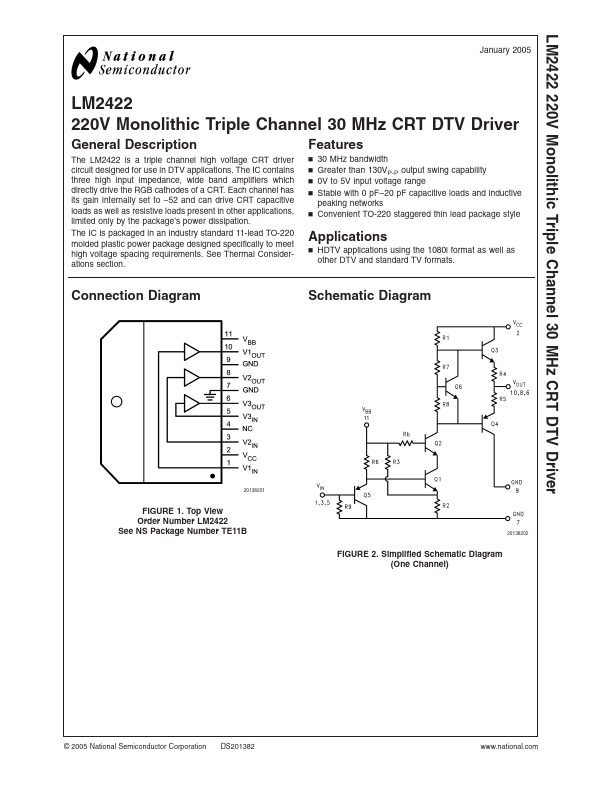
The LM2422 is a triple channel high voltage CRT driver circuit designed for use in DTV applications. The IC contains three high input impedance, wide band amplifiers which directly drive the RGB cathodes of a CRT. Each channel has its gain internally set to
- 52 and can drive CRT capacitive loads as well as resistive loads present in other applications, limited only by the package’s power dissipation. The IC is packaged in an industry standard 11-lead TO-220 molded plastic power package designed specifically to meet high voltage spacing requirements. See Thermal Considerations section.
Features
30 MHz bandwidth Greater than 130VP-P output swing capability 0V to 5V input voltage range Stable with 0 p F- 20 p F capacitive loads and inductive peaking networks n Convenient TO-220 staggered thin lead package style n n n n
Applications n HDTV applications using the 1080i format as well as other DTV and standard TV formats.
Connection Diagram
Schematic Diagram
FIGURE 1. Top View Order Number LM2422 See NS Package Number TE11B FIGURE 2. Simplified Schematic Diagram (One Channel)
© 2005 National Semiconductor Corporation
DS201382
.national.
Absolute Maximum Ratings
3)
(Notes 1,
Operating Ratings (Note 2)
VCC VBB VIN VOUT Case Temperature (22W max power) +100V to +230V +7V to +13V +0V to +5V +40V to +215V 110˚C
If Military/Aerospace specified devices are required, please contact the National Semiconductor Sales Office/ Distributors for availability and specifications. Supply Voltage (VCC) Bias Voltage (VBB) Input Voltage (VIN) Storage Temperature Range (TSTG) Lead Temperature (Soldering, < 10 sec.) ESD Tolerance, Human Body Model Machine Model Junction Temperature θJC (typ) 2 k V 200V 150˚C 1.8˚C/W 300˚C +250V +16V
- 0.5V to VBB +0.5V
- 65˚C to +150˚C
Do not operate the part without a heat sink. Heat sink must have a thermal resistance under 2.3˚C/W. (Note 7)
Electrical Characteristics
(See Figure 3 for Test Circuit). Unless...