LM4752
LM4752 is Stereo 11W Audio Power Amplifier manufactured by National Semiconductor.
Description
The LM4752 is a stereo audio amplifier capable of delivering 11W per channel of continuous average output power to a 4Ω load, or 7W per channel into 8Ω using a single 24V supply at 10% THD+N. The LM4752 is specifically designed for single supply operation and a low external ponent count. The gain and bias resistors are integrated on chip, resulting in a 11W stereo amplifier in a pact 7 pin TO220 package. High output power levels at both 20V and 24V supplies and low external ponent count offer high value for pact stereo and TV applications. A simple mute function can be implemented with the addition of a few external ponents. n PO at 10% THD @ 1 k Hz into 8Ω bridged TO-263 pkg. at VCC = 12V 5W (typ)
Features n n n n n n n n Drives 4Ω and 8Ω loads Internal gain resistors (AV = 34 d B) Minimum external ponent requirement Single supply operation Internal current limiting Internal thermal protection pact 7 lead TO-220 package Low cost-per-watt
Key Specifications n Output power at 10% THD+N with 1 k Hz into 4Ω at V CC = 24V 11W (typ) n Output power at 10% THD+N with 1 k Hz into 8Ω at V CC = 24V 7W (typ) n Closed loop gain 34 d B (typ) n PO at 10% THD @ 1 k Hz into 4Ω Single-ended TO-263 pkg. at VCC = 12V 2.5W (typ)
Applications n n n n pact stereos Stereo TVs Mini ponent stereos Multimedia speakers
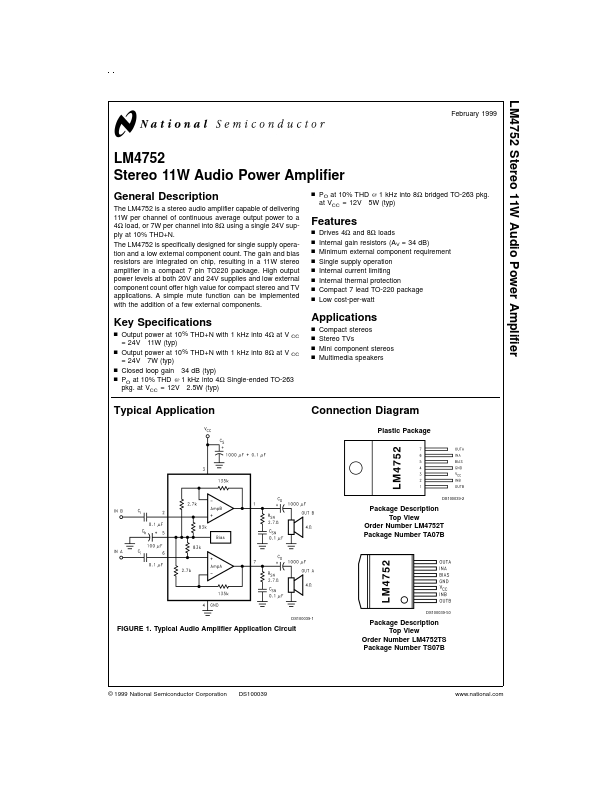
Typical Application
Connection Diagram
Plastic Package
DS100039-2
Package Description
Top View Order Number LM4752T Package Number TA07B
DS100039-50 DS100039-1
FIGURE 1. Typical Audio Amplifier Application Circuit
Package Description
Top View Order Number LM4752TS Package Number TS07B
© 1999 National Semiconductor Corporation
DS100039
.national.
Absolute Maximum Ratings (Note 2)
If Military/Aerospace specified devices are required, please contact the National Semiconductor Sales Office/ Distributors for availability and specifications. Supply Voltage Input Voltage Output Current Power Dissipation (Note 3) ESD Susceptability (Note 4) Junction Temperature...