LM4876
LM4876 is 1.1W Audio Power Amplifier manufactured by National Semiconductor.
Description
The LM4876 is a bridge-connected audio power amplifier capable of delivering typically 1.1W of continuous average power to an 8Ω load with 0.5% (THD) from a 5V power supply. Boomer audio power amplifiers were designed specifically to provide high quality output power with a minimal amount of external ponents. Since the LM4876 does not require output coupling capacitors, bootstrap capacitors, or snubber networks, it is optionally suited for low-power portable systems. The LM4876 features an externally controlled, low-power consumption shutdown mode, which is achieved by driving pin 1 with logic low. Additionally, the LM4876 features an internal thermal shutdown protection mechanism. The LM4876 is unity-gain stable and can be configured by external gain-setting resistors.
Key Specifications n THD at 1 k Hz at 1W continuous average output power into 8Ω n Output power at 10% THD+N at 1 k Hz into 8Ω n Shutdown Current 0.5% (max) 1.5W (typ) 0.01 µA (typ)
Features n No output coupling capacitors, bootstrap capacitors, or snubber circuits are necessary n Small Outline packaging n Unity-gain stable n External gain configuration capability n Pin patible with LM4861 and LM4871
Applications n n n n Mobile Phones Portable puters Desktop puters Low Voltage Audio Systems
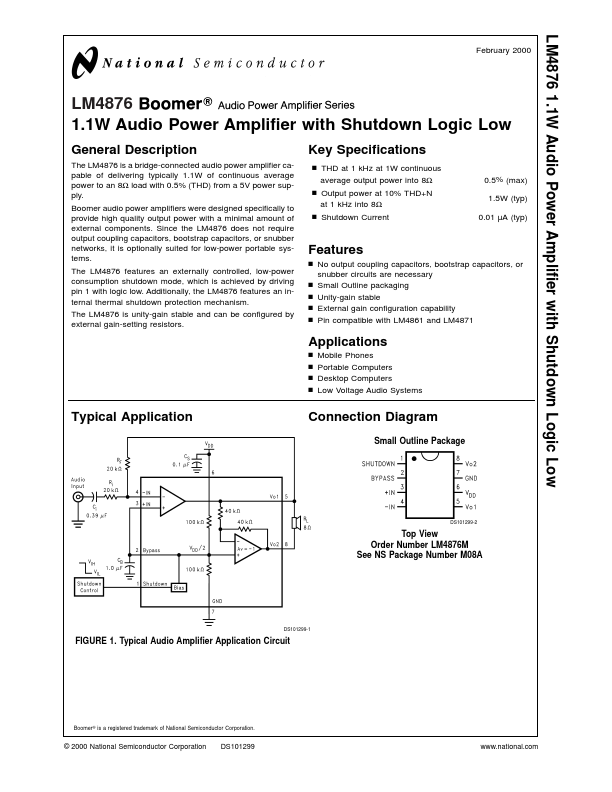
Typical Application
Connection Diagram
Small Outline Package
DS101299-2
Top View Order Number LM4876M See NS Package Number M08A
DS101299-1
FIGURE 1. Typical Audio Amplifier Application Circuit
Boomer ® is a registered trademark of National Semiconductor Corporation.
© 2000 National Semiconductor Corporation
DS101299
.national.
Absolute Maximum Ratings (Note 2)
If Military/Aerospace specified devices are required, please contact the National Semiconductor Sales Office/ Distributors for availability and specifications. Supply Voltage Storage Temperature Input Voltage Power Dissipation (Note 3) ESD Susceptibility (Note 4) ESD Susceptibility (Note 5) Junction Temperature Soldering...