LM4878
LM4878 is 1Watt Audio Power Amplifier manufactured by National Semiconductor.
Description
The LM4878 is a bridge-connected audio power amplifier capable of delivering 1 W of continuous average power to an 8Ω load with less than .2% (THD) from a 5V power supply. Boomer audio power amplifiers were designed specifically to provide high quality output power with a minimal amount of external ponents. Since the LM4878 does not require output coupling capacitors or bootstrap capacitors. It is optimally suited for low-power portable applications. The LM4878 features an externally controlled, low-power consumption shutdown mode, as well as an internal thermal shutdown protection mechanism. The unity-gain stable LM4878 can be configured by external gain-setting resistors.
Key Specifications j Power Output at 0.2% THD j Shutdown Current
1 W (typ) 0.01 µA (typ)
Features n n n n n n Internal pulldown resistor on shutdown. micro SMD package (see App. note AN-1112) 5V
- 2V operation No output coupling capacitors or bootstrap capacitors. Unity-gain stable External gain configuration capability
Applications n Cellular Phones n Portable puters n Low Voltage Audio Systems
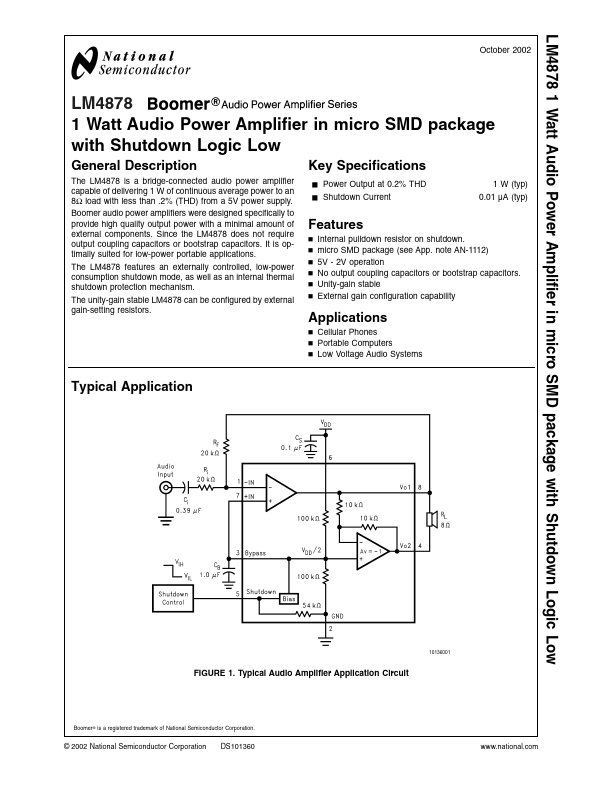
Typical Application
FIGURE 1. Typical Audio Amplifier Application Circuit
Boomer ® is a registered trademark of National Semiconductor Corporation.
© 2002 National Semiconductor Corporation
DS101360
.national.
Connection Diagrams
8 Bump micro SMD
Top View Order Number LM4878IBP, LM4878IBPX See NS Package Number BPA08B6B micro SMD Marking
Top View X
- Date Code T
- Die Traceability G
- Boomer Family D
- LM4878IBP
.national.
Absolute Maximum Ratings
(Note 2)
Soldering Information See AN-1112 ’Micro-SMD Wafers Level Chip Scale Package’.
If Military/Aerospace specified devices are required, please contact the National Semiconductor Sales Office/ Distributors for availability and specifications. Supply Voltage Storage Temperature Input Voltage Power Dissipation (Note 3) ESD Susceptibility (Note 4) ESD Susceptibility (Note 5)...