LM4918
LM4918 is Stereo Audio Amp manufactured by National Semiconductor.
Description
The LM4918 is a monolithic integrated circuit that provides a automatic gain control (AGC), and stereo bridged audio power amplifiers capable of producing 1W into 8Ω with less than 1.0% THD. Boomer ® audio integrated circuits were designed specifically to provide high quality audio while requiring a minimum amount of external ponents. The LM4918 incorporates a AGC and stereo bridged audio power amplifiers making it optimally suited for multimedia monitors, portable radios, desktop and portable puter applications. The LM4918 features an externally controlled, low-power consumption shutdown mode, and a power amplifier mute for maximum system flexibility and performance.
Key Specifications j THD+N at 1k Hz, 1W, 8Ω j Total quiescent power supply current j Total shutdown power supply current
0.3% (typ) 18m A (typ) 1µA (typ)
Features n n n n n n 0.75d B per step/32step AGC Control Interface Automatic Gain Control Circuitry Stereo Bridged power amplifiers “Click and pop” suppression circuitry Thermal shutdown protection circuitry Selectable Auto Detect Std-by mode and Logic control
Applications n Portable puters n Desktop puters n Multimedia monitors
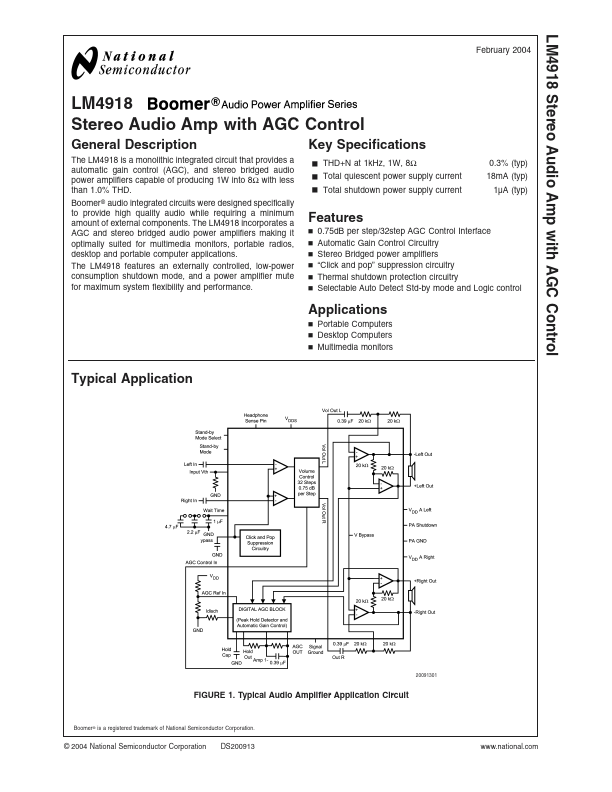
Typical Application
FIGURE 1. Typical Audio Amplifier Application Circuit
Boomer ® is a registered trademark of National Semiconductor Corporation.
© 2004 National Semiconductor Corporation
DS200913
.national.
Connection Diagrams
LQ Package
Top View Order Number LM4918LQ See NS Package Number LQA32B LQ Marking
200913H7
Top View NS
- Std NS Logo U
- Wafer Fab Code Z
- Assembly Plant Code XY
- 2 Digit Date Code TT
- Die Run Traceability L4918LQ
- LM4918LQ
.national.
Absolute Maximum Ratings (Note 2)
If Military/Aerospace specified devices are required, please contact the National Semiconductor Sales Office/ Distributors for availability and specifications. Supply Voltage Storage Temperature Input Voltage Power Dissipation (Note 3) ESD Susceptibility (Note 4) ESD...