LM61
LM61 is 2.7V/ SOT-23 or TO-92 Temperature Sensor manufactured by National Semiconductor.
Description
The LM61 is a precision integrated-circuit temperature sensor that can sense a
- 30˚C to +100˚C temperature range while operating from a single +2.7V supply. The LM61’s output voltage is linearly proportional to Celsius (Centigrade) temperature (+10 m V/˚C) and has a DC offset of +600 m V. The offset allows reading negative temperatures without the need for a negative supply. The nominal output voltage of the LM61 ranges from +300 m V to +1600 m V for a
- 30˚C to +100˚C temperature range. The LM61 is calibrated to provide accuracies of ± 2.0˚C at room temperature and ± 3˚C over the full
- 25˚C to +85˚C temperature range. The LM61’s linear output, +600 m V offset, and factory calibration simplify external circuitry required in a single supply environment where reading negative temperatures is required. Because the LM61’s quiescent current is less than 125 µA, self-heating is limited to a very low 0.2˚C in still air. Shutdown capability for the LM61 is intrinsic because its inherent low power consumption allows it to be powered directly from the output of many logic gates.
Applications n n n n n n n n n Cellular Phones puters Power Supply Modules Battery Management FAX Machines Printers HVAC Disk Drives Appliances
Key Specifications n Accuracy at 25˚C n Accuracy for
- 30˚C to +100˚C n Accuracy for
- 25˚C to +85˚C n Temperature Slope n Power Supply Voltage Range n Current Drain @ 25˚C n Nonlinearity n Output Impedance
± 2.0 or ± 3.0˚C
(max)
± 4.0˚C (max) ± 3.0˚C (max)
+10 m V/˚C +2.7V to +10V 125 µA (max)
Features n Calibrated linear scale factor of +10 m V/˚C n Rated for full
- 30˚ to +100˚C range n Suitable for remote applications
± 0.8˚C (max)
800 Ω (max)
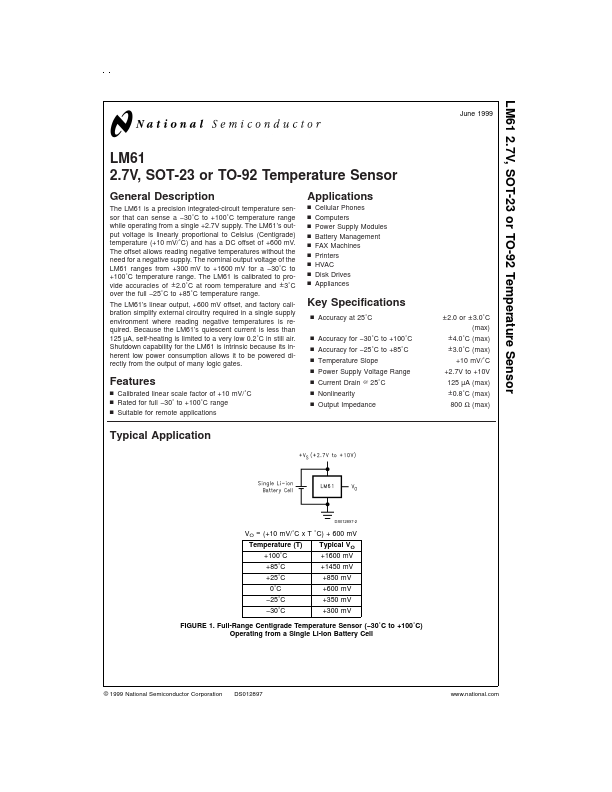
Typical Application
DS012897-2
VO = (+10 m V/˚C x T ˚C) + 600 m V Temperature (T) +100˚C +85˚C +25˚C 0˚C
- 25˚C
- 30˚C Typical VO +1600 m V +1450 m V +850 m V +600 m V +350 m V +300 m V
FIGURE 1. Full-Range Centigrade Temperature Sensor (- 30˚C to +100˚C) Operating from a Single Li-Ion Battery Cell
© 1999 National...