LMD18200
LMD18200 is 3A / 55V H-Bridge manufactured by National Semiconductor.
Description
The LMD18200 is a 3A H-Bridge designed for motion control applications. The device is built using a multi-technology process which bines bipolar and CMOS control circuitry with DMOS power devices on the same monolithic structure. Ideal for driving DC and stepper motors; the LMD18200 acmodates peak output currents up to 6A. An innovative circuit which facilitates low-loss sensing of the output current has been implemented. n n n n n n No “shoot-through” current Thermal warning flag output at 145˚C Thermal shutdown (outputs off) at 170˚C Internal clamp diodes Shorted load protection Internal charge pump with external bootstrap capability
Applications n n n n n DC and stepper motor drives Position and velocity servomechanisms Factory automation robots Numerically controlled machinery puter printers and plotters
Features n n n n Delivers up to 3A continuous output Operates at supply voltages up to 55V Low RDS(ON) typically 0.3Ω per switch TTL and CMOS patible inputs
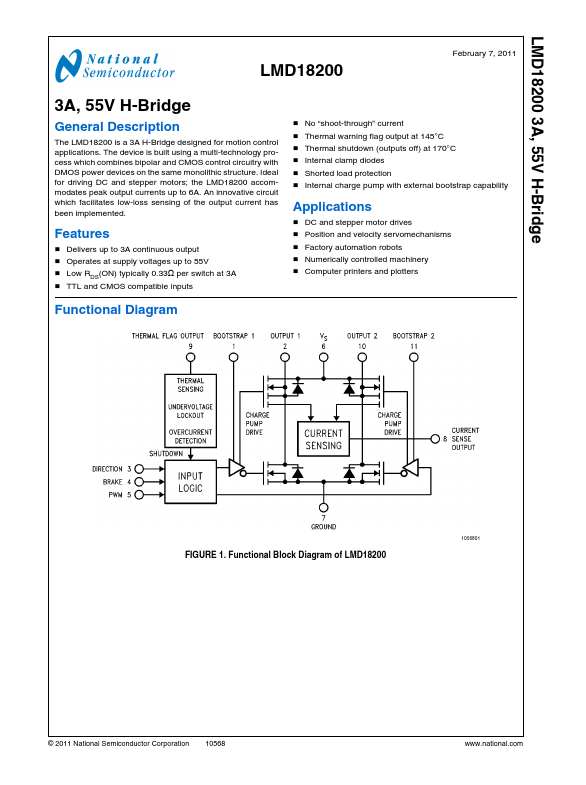
Functional Diagram
DS010568-1
FIGURE 1. Functional Block Diagram of LMD18200
© 1999 National Semiconductor Corporation
DS010568
.national.
Connection Diagrams and Ordering Information
DS010568-2
11-Lead TO-220 Package Top View Order Number LMD18200T See NS Package TA11B
DS010568-25
24-Lead Dual-in-Line Package Top View Order Number LMD18200-2D-QV 5962-9232501VXA LMD18200-2D/883 5962-9232501MXA See NS Package DA24B
.national.
Absolute Maximum Ratings (Note 1)
If Military/Aerospace specified devices are required, please contact the National Semiconductor Sales Office/ Distributors for availability and specifications. Total Supply Voltage (VS, Pin 6) Voltage at Pins 3, 4, 5, 8 and 9 Voltage at Bootstrap Pins (Pins 1 and 11) Peak Output Current (200 ms) Continuous Output Current (Note 2) Power Dissipation (Note 3) 60V 12V VOUT +16V 6A 3A 25W
Power Dissipation (TA = 25˚C, Free Air) Junction Temperature, TJ(max) ESD Susceptibility (Note 4) Storage Temperature,...