LMH6639
LMH6639 is 190MHz Rail-to-Rail Output Amplifier manufactured by National Semiconductor.
Description
The LMH6639 is a voltage feedback operational amplifier with a rail-to-rail output drive capability of 110m A. Employing National’s patented VIP10 process, the LMH6639 delivers a bandwidth of 190MHz at a current consumption of only 3.6m A. An input mon mode voltage range extending to 0.2V below the V- and to within 1V of V+, makes the LMH6639 a true single supply op-amp. The output voltage range extends to within 30m V of either supply rail providing the user with a dynamic range that is especially desirable in low voltage applications. The LMH6639 offers a slew rate of 172V/µs resulting in a full power bandwidth of approximately 28MHz. The TON value of 83nsec bined with a settling time of 33nsec makes this device ideally suited for multiplexing applications. Careful attention has been paid to ensure device stability under all operating voltages and modes. The result is a very well behaved frequency response characteristic for any gain setting including +1, and excellent specifications for driving video cables including harmonic distortion of
- 60d Bc, differential gain of 0.12% and differential phase of 0.045˚
Features
(VS = 5V, Typical values unless specified) n Supply current (no load) 3.6m A n Supply current (off mode) 400µA n Output resistance (closed loop 1MHz) 0.186Ω n
- 3d B BW (AV = 1) 190MHz n Settling time 33nsec n Input mon mode voltage
- 0.2V to 4V n Output voltage swing 40m V from rails n Linear output current 110m A n Total harmonic distortion
- 60d Bc n Fully characterized for 3V, 5V and ± 5V n No output phase reversal with CMVR exceeded n Excellent overdrive recovery n Off Isolation 1MHz
- 70d B n Differential Gain 0.12% n Differential Phase 0.045˚
Applications n n n n n Active filters CD/DVD ROM ADC buffer amplifier Portable video Current sense buffer
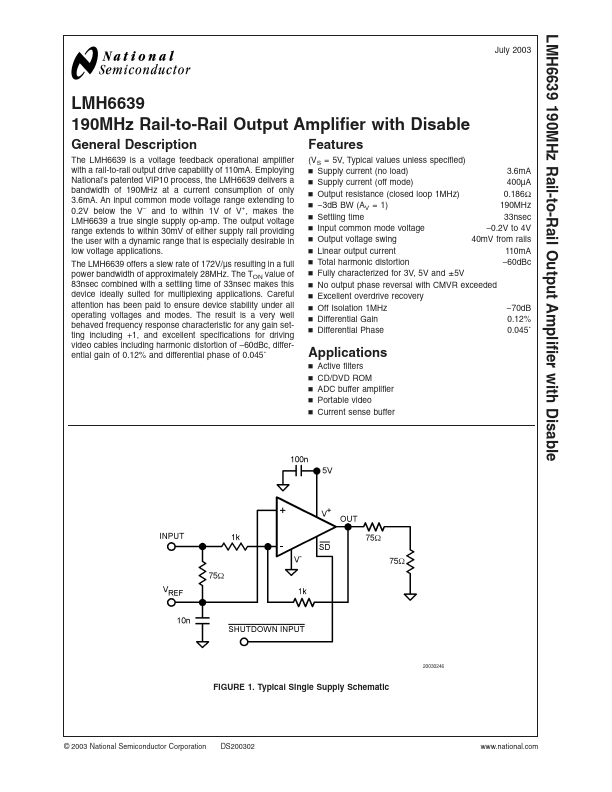
FIGURE 1. Typical Single Supply Schematic
© 2003 National Semiconductor Corporation
DS200302
.national.
Absolute Maximum Ratings
(Note 1)
Junction Temperature (Note 4)...